
Team friction isn't personal.
It's mental energy looking for direction.
Team Intelligence shows you the map of how your team thinks — where each person sits, where the team clusters, where decisions stall, where energy waits. Then it gives you Clara, an AI guide who reasons from your team’s actual cognitive composition, in real time. The science is twenty-five years old. Clara joined the room in 2025.
Start here — no card, no sales call
Try Team Intelligence on yourself, right now.
Take the four-minute MindTime Profile, receive your three personal reports, and meet your Personal Clara — your own data, the real experience. Then step into Nordexia, our demo team, for the team-level surfaces: the cognitive map, the team reports, and Team Clara. The personal layer is yours. The team layer is illustrated through Nordexia. Roughly eighty percent of the real onboarding experience is available before you ask us anything.
You are leading your team partly blind.
Personality tests tell you what people are like. Engagement surveys tell you how they feel. Neither tells you how they think.
You have seen the symptoms. The meeting where everyone nods and nothing happens afterward. The project that stalls for reasons no-one can name. The two people who should collaborate brilliantly and somehow cannot find a rhythm. The hire who was right on paper and never quite landed.
These are not effort problems and they are not intent problems. They are cognitive composition problems — patterns in how a team thinks together that nobody in the room can see from inside the room. You cannot manage cognitive dynamics you cannot see.
Team Intelligence makes them visible — and gives you Clara to work with what becomes visible.


Where MindTime has done its work.


What you actually get
Three layers, one platform.
Team Intelligence is one product with three layers — what each person gets, what the team gets together, and what the leader gets across the whole engagement. Here is what that means in concrete terms.
For each person
Their own cognitive signature.
Four-minute MindTime Profile
One short assessment. Three numbers — Past, Present, Future — with a clear visual position.
Three personal reports
Cognitive Signature, Deep Dive, and Personal Growth. Written for the individual, not the team.
Personal Clara
An AI guide that adapts to how the person thinks. Private. Theirs alone.
World of MindTime
An ongoing knowledge academy. Short, useful, designed to be returned to.
For the team
The shape of how you think together.
Interactive cognitive map
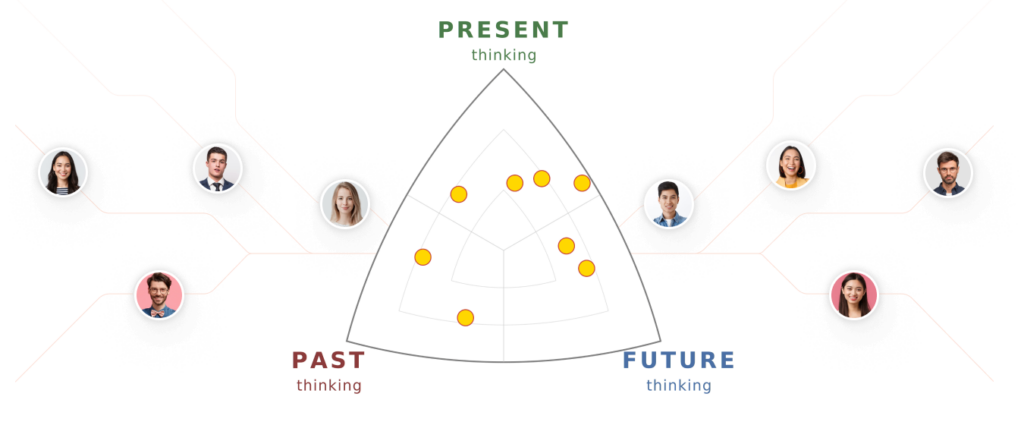
Every team member plotted on the Past · Present · Future field. Clickable profile cards. The team’s centre of gravity, visible.
Team Diagnostic Report
Including the structural pattern named for your team — the specific shape your team is, not a generic archetype.
Team Development Plan
Concrete scaffolds for the moves the team can make next, written from the team’s actual map.
Team Clara
An AI guide aware of the whole team’s composition — privately. Reasons from the shape, not from any one person’s data.
For the leader
A measurable before and after.
Team competency baseline
A short survey built on Google’s team research — psychological safety, dependability, structure, meaning, impact.
Ongoing leader workspace
Your team’s map, reports, and Clara conversations, all in one place. Returnable across the year.
After-measure
The same competency survey, run again later. You see what changed, in your team’s own numbers.
Hands-on support
The MindTime team is reachable throughout — by design, not by exception.
What Clara does
Clara is a thinking partner who knows how the room thinks. Not a chatbot.
Clara is the AI guide built into Team Intelligence. She launched in 2025. She is shaped by twenty-five years of MindTime research, hundreds of team deployments, and — once you join — by the actual cognitive composition and context of your team. The flavour of the conversation, by way of illustration:
Personal Clara — what you might ask
Things she's already good at.
“How am I likely to be misread by people who think differently to me?”
“I have a hard conversation tomorrow. How do I prepare given how I think?”
“What energises me, what drains me, and why?”
Team Clara — what the team can ask
Where it gets interesting.
“We have been stuck on this decision for three meetings. What’s happening in the room cognitively?”
“A new person joins next week. How do we onboard them given our team’s shape?”
“Where is our blind spot, and how do we work with it?”
Conversations with Personal Clara stay with the individual — they are never visible to other team members, to the leader, or to Team Clara. Team Clara reasons from the team’s cognitive vectors and the team’s shared context, not from anyone’s private conversations.
From the field
What happens when Clara becomes a presence in the room.
The MindTime framework has been used in team contexts for more than twenty years — in workshops, offsites, and leadership programmes, almost always with a trained facilitator present. Clara joined the room in 2025. Here is what happened the first time a facilitator turned to Clara for help mid-session.

Five leaders had been deadlocked for over an hour. Clara diagnosed the structural cause in seconds.
The facilitator queried Clara mid-session, drawing on the group’s MindTime profiles. Three members were Future-Possibility dominant. One was a strong Past-Certainty thinker who needed proof and precedent before moving. The fifth was a Present-Probability thinker caught between them. Clara didn’t just name it — she scripted the intervention, with exact language and a role for each person.
"You have three strong Future thinkers trying to fly the plane to 2028. And you have one strong Past thinker who is checking if we have enough fuel and if the runway is paved. You aren't disagreeing on the goal. You are disagreeing on the starting point."
The facilitator shared the framing with the group. Naming the cognitive collision broke the deadlock. The quietest person in the room — the Present-Probability thinker — moved from the periphery to the centre through the role she was assigned. For the rest of the offsite, the facilitator added MindTime profiles to the name cards as a persistent visual reference.
"The tool didn't just provide generic outputs — it appeared to learn and respond within the nuances of our business environment, making the experience feel genuinely personalised and relevant. It knew me, and responded to me."
Once Team Intelligence is in the room, the room starts working differently.
Team Intelligence is less a tool you deploy than a presence that becomes part of how the team works. Some of what it does happens fast — within the first week, people start recognising themselves on the map and the language begins to shift. Some of it takes the full quarter — the team develops a shared operating vocabulary, and the leader stops being the only person carrying certain questions. Here is what tends to unfold.
People feel seen.
Psychological safety arrives faster than anyone expects. When a team member’s cognitive blueprint is named accurately — including the things they have always intuited but never quite had words for — they feel represented in a way other team frameworks rarely produce. Clara, who knows the team’s context, deepens this. People are not being typed by an algorithm. They are being recognised by a guide who knows the cognitive patterns at work intimately.
Friction redirects to collaboration.
The thing that has been reading as a personality clash gets a different name. She is not being slow — she is building certainty. He is not being unfocused — he is scanning for what is possible. She is not being inflexible — she is keeping things in motion. When the cognitive difference can be named, the energy that was bleeding into friction starts flowing back into the work. The validator stops being the brake. The scanner stops being the scattered one. The roles become productive instead of frustrating.
Communication adjusts to how people actually receive it.
A leader who can see how each person on the team thinks can adjust what they say, and how. Strong Future thinkers need to know the deadline and why it matters by then. Strong Present thinkers need the structure, the plan, the path that makes the work concrete. Strong Past thinkers need the data, or access to the data sources, so they can validate the move. These are not personality preferences. They are how the cognitive architecture takes in information. When a leader gets this right, alignment stops being a struggle.
Leaders test their thinking with Clara before it lands in the room.
This one is less obvious and quietly transformative. Before a leader takes a difficult message to the team — a strategic shift, a piece of hard feedback, a call on priorities — they can sit with Clara, who knows the team, and ask: given how this team thinks, how is this likely to land? What am I about to miss? Where is the language I am planning to use going to cause confusion rather than alignment? What the team receives is a message that has already been pressure-tested against the room it is about to enter.
Whole Thinking becomes how the team works.
Over the quarter, Whole Thinking stops being a concept and becomes the team’s vocabulary. Members recognise their own moves and each other’s. The leader’s sentences pick up the team’s shared language. Decisions get framed in terms of what Past, Present, and Future each ask of this choice. This is the most durable change, and the one that compounds — long after the formal engagement ends.
Pushback becomes information.
The shift works the other way too. When you can hear that a team member is not just disagreeing with you but is reaching from a different cognitive starting point, the conversation changes shape. Pushback stops being noise to manage. It becomes useful information about what the team’s thinking is doing. Leaders consistently report this is the change they feel before they can name.
Then there are the more specific moments where Team Intelligence does direct work. Onboarding a new team member, so the team is already in conversation when the new person arrives. Reading the team’s shape to see the cognitive signature missing from its current composition — and choosing whether to hire for it, borrow it, or hold it. Running a meeting that has been stuck for weeks because nobody could name what the stuckness actually was. These moments are real and significant. They are not the headline. The headline is the texture change that happens day to day.
Not another personality test.
Team Intelligence is built on the MindTime framework — a model of human cognition developed and validated over twenty-five years, with peer-reviewed publication across psychology, marketing, and organisational research. The framework is measured by the MindTime Profile, a four-minute assessment that produces your unique Past · Present · Future ratio.
Where MBTI, DISC, or the Big Five (OCEAN) describe behavioural preferences or personality traits, MindTime measures the cognitive architecture underneath: how a person orients to Past, Present, and Future when they take in information and make decisions. This is not a typology. Every person carries all three orientations. The MindTime Profile measures the unique ratio — your cognitive blueprint — and from that ratio Team Intelligence generates insight no personality framework can produce.
The Profile works across cultures and languages. It is the engine Clara reasons from.
25+ years
The MindTime framework
Peer-reviewed, used in team contexts for two decades.
~2.5 years
MTAI
The AI evolution of the framework.
2025
Clara launches
The AI guide that brings it all into the room.

What is shared, what is private
The team sees the team. Your conversations stay with you.
Team Intelligence works because the cognitive shape of the team is visible to the team. People being seen by each other — accurately — is where psychological safety starts.
Every team member can see every other team member’s cognitive profile and map position. That is the point. The cognitive shape of the team has to be visible to the team for the team to work with it. Each person’s three personal reports — Cognitive Blueprint, Deep Dive, Personal Growth — are theirs, written for them, available to share if they choose.
What is private is each person’s conversation with Personal Clara. Those exchanges stay between the individual and their guide. They are never visible to other team members, to the team leader, or to anyone else. Team Clara reasons from the team’s collective shape and shared context — not from the private conversations members are having on the side.
Trusted by leaders, facilitators, educators
What people say after using it.
Two ways in.
Whether you have one curious afternoon or a team that is ready to move, there is a way in that fits.
Right now · free
Try Team Intelligence on yourself.
Take the four-minute profile, get your three reports, meet your Personal Clara on your own data. Then explore the team layer through Nordexia, our demo team. No sign-up, no sales call.
Talk to us
Request a demo for your team.
If you are considering Team Intelligence at organisational scale, or you have a specific team situation you would like to walk through, we will set up a conversation. Thirty minutes, no obligation.
Answers, in plain terms.
Team Intelligence is MindTime’s team development programme. It maps the thinking styles of every team member — Past, Present, and Future — then uses four built-in diagnostics to predict how the group’s cognitive diversity will affect communication, decision-making, and performance.
Each team member completes the MindTime Profile — four minutes. Their result generates three personal reports and unlocks their Personal Clara. At the team level, every member’s profile is plotted on the team’s cognitive map. The platform produces a Team Diagnostic Report (including the structural pattern named for your specific team), a Team Development Plan, and gives the team access to Team Clara. Roughly ten minutes per person, total, gets the whole platform running.
A MindTime Map is a visual representation of thinking styles within a group. Each person appears as a dot positioned by their blend of Past, Present, and Future thinking — making it immediately clear where the team’s cognitive strengths and blind spots are.
Clara has two roles. Personal Clara works with each team member privately on their own cognitive profile — preparing for hard conversations, decoding why certain situations drain or energise them, working on growth. Team Clara works with the team as a whole, reasoning from the team’s collective shape — diagnosing why a decision has stalled, planning the onboarding of a new member, naming a blind spot the team has been working around. Both Claras are grounded in twenty-five years of MindTime research and are aware of context, not just data.
Personality tests describe behavioural preferences and tend to sort people into types. MindTime measures the cognitive architecture underneath behaviour — how a person orients to Past, Present, and Future when processing information. It is not a typology. Every person carries all three orientations; what differs is the ratio. The platform is built around that ratio, with Clara reasoning from it. The framework is peer-reviewed and has been deployed in team contexts for more than twenty years.
Cognitive profiles and map positions are visible to every team member — that is the point of Team Intelligence. The cognitive shape of the team has to be visible to the team for the team to work with it. What is private is each person’s conversation with Personal Clara. Those exchanges stay between the individual and their guide and are never visible to other team members, to the team leader, or to anyone else. Team Clara reasons from the team’s collective shape and shared team context, not from private conversations.
Yes — that is the question Team Intelligence is built to answer. For twenty years, MindTime was deployed in team contexts almost always with a trained facilitator in the room. Clara, launched in 2025, is the AI partner who makes the framework usable directly by a team leader. This is what the Early Adopter Pilot is testing — five teams of working leaders using the platform on their own, with Clara as the guide, and our team available for support throughout.
Yes. Team Intelligence supports multiple teams, cross-team analysis, and organisation-wide deployment, with cognitive maps across departments and the ability to look at composition at any level of the org. For organisations exploring that scale of deployment, we recommend starting with a conversation — request a demo.
The MindTime framework has been developed and refined for more than twenty-five years, with peer-reviewed publication across multiple disciplines. It has been used in team contexts — workshops, offsites, leadership programmes — for over twenty years. MTAI, the AI evolution of the framework, is approximately two and a half years old. Clara, the AI guide built into Team Intelligence, launched in 2025.
Stop Guessing How Your Team Thinks.
The best teams are not built on chemistry. They are built on cognitive clarity — understanding how each person processes information, makes decisions, and creates meaning. Team Intelligence gives you that clarity. Clara makes it actionable.

MindTime is the human science behind how we think. Built on 25 years of research, it reveals the hidden architecture of thought; past, present, and future. It empowers people to understand one another in profoundly meaningful ways though a powerful framework for trust, collaboration, and human-aligned technology.
Experience it through Clara — AI built on real cognitive science. Experience Clara.
Useful links
Cookie Consent
We use cookies to improve your experience on our site. By using our site, you consent to cookies.
This website uses cookies
Websites store cookies to enhance functionality and personalise your experience. You can manage your preferences, but blocking some cookies may impact site performance and services.
Essential cookies enable basic functions and are necessary for the proper function of the website.
These cookies are needed for adding comments on this website.