
Team friction isn't personal. It's thinking looking for direction.
Team Intelligence shows you the map and gives you the guide to understand how your team thinks, your team's dynamics, and how to direct each team member's thinking to optimise the team.
You can't direct something you can't quantify and understand. Seeing individual thinking means having a map to navigate each and every conversation.
“Understanding that we view issues and challenges through our own lens has been incredibly powerful.”Rikard Kjellberg · COO, b-yond
No card. No sales call. Just four minutes.
See exactly what your own team's map will feel like — before you invite a single person.
Complete your four-minute profile
A short profile shows how you relate to the past, present, and future. You immediately receive your Thinking Profile Summary, Full Thinking Profile, and Personal Growth.
Meet Personal Clara
Your private AI guide uses your thinking profile and any context you choose to provide to help you explore how you think, decide, and work with others.
Explore a live team map
Walk through Nordexia — an interactive demonstration team — and see the Team Map, team analysis, and Team Clara in action.
You are leading your team partly blind.
You can see what your team does — the output, the friction, the meeting that stalls for the third time. What you can't see is why.
Two people clash and it looks like personality. A decision stalls and it looks like resistance. A strong idea dies in the room and it looks like politics. Sometimes the underlying issue is different: people are approaching the same situation from different perspectives — some anchored in the proven past, some in the live present, some in the possible future — and without a shared map, that difference can look like conflict.
Team Intelligence gives you the map, and helps you and your team explore what it means for how you work together.
Three layers, one platform.
A shared framework, working at three levels at once.
Individual
Each person receives a private thinking profile, the Thinking Profile Summary, Full Thinking Profile, Personal Growth, and Personal Clara — self-awareness that's theirs alone.
Team
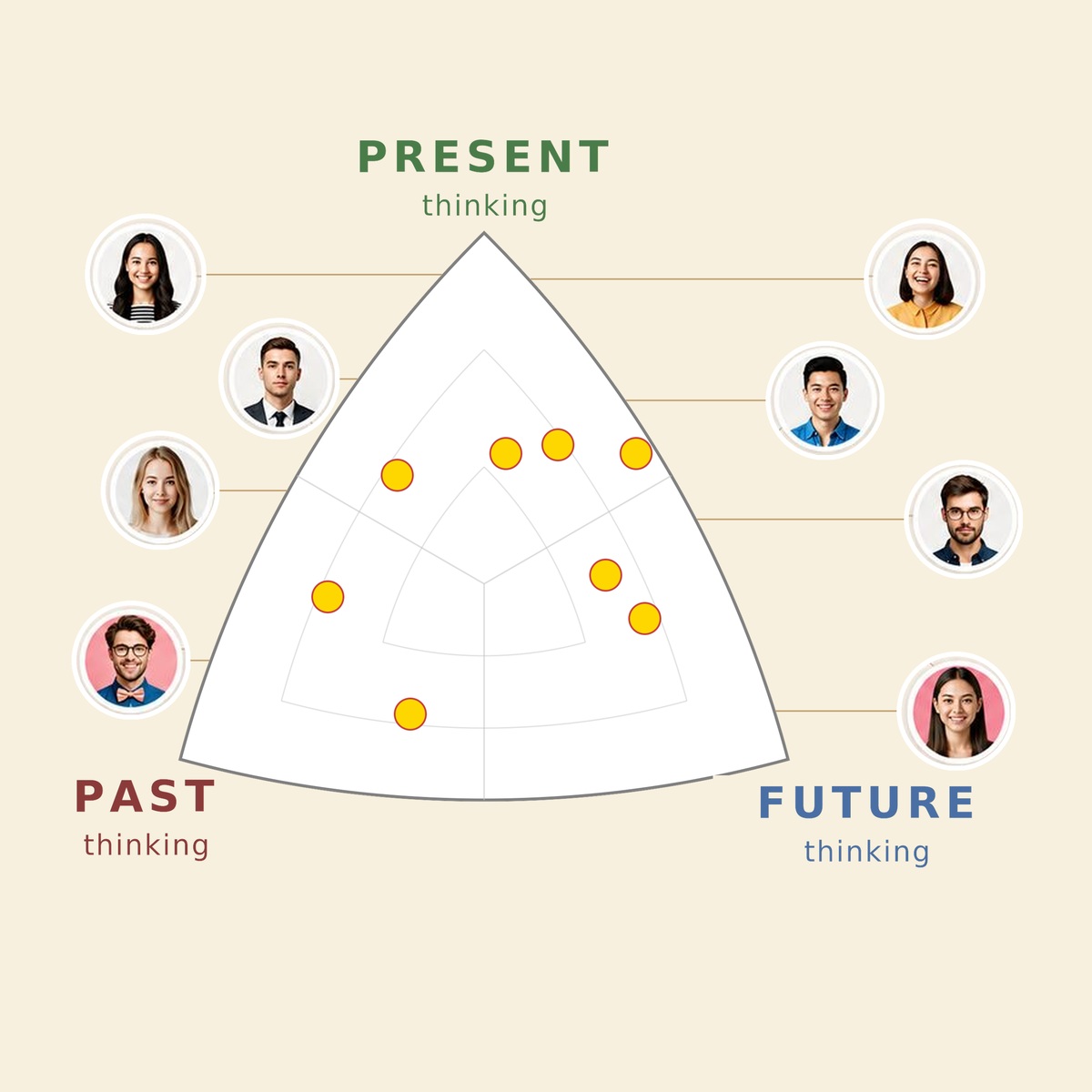
The Team Map shows how the team's thinking is distributed — where perspectives cluster and which perspectives may be less represented.
Leader
Team Clara offers guidance grounded in the team's actual thinking profiles and any context users deliberately supply.
An AI guide designed around how people think — not a general-purpose chatbot.
Personal Clara and Team Clara are two sides of one guide, living in a single Team Intelligence platform — one unified experience. Clara works from thinking profiles and any context you deliberately provide, and the line between private and team-level information is kept.
Personal Clara
Your own confidential guide. Personal Clara uses your thinking profile and the context you choose to share. Personal conversations are not shown to other team members, to the leader, or to Team Clara — per the Privacy Policy.
Team Clara
Guidance drawn from the team's thinking profiles and team context users deliberately provide. Team Clara does not use Personal Clara conversations, and does not autonomously monitor the room.
What changes when a team sees itself.
The leadership team of Q8's Spanish operating unit had worked together for many years. They had each other filed under fixed roles — the careful one, the difficult one, the one who always brings a problem. Then the Team Map showed them clustered in almost the same place: strongly Present, less Past, less Future. Nearly the same kind of thinker, all along.
“Once they see them clustered in the same space, we are more or less the same kind of animal. At the end we are more or less of the same flesh and blood. And so this helped a lot the collaboration.”Max, Managing Director, KP Spain
Accumulated labels started to come off — and the team was able to talk more openly about how it actually thinks together.
Priced by who you are — openly, on the front of the box.
An NHS trust, a refugee charity, and a global agency don't have the same access to capital. So we don't charge them the same. FairShare sets a transparent list price by organization type.
| Organization type | 90-day Team Intelligence experience (per person) | Continuing subscription (per person / month, billed annually) |
|---|---|---|
| Global Commercial Enterprise | $289 | $100 |
| SME / Commercial Startup | $162.50 | $65 |
| Private Education | $112.50 | $45 |
| Social Impact / B Corp | $87.50 | $35 |
| Nonprofit | $62.50 | $25 |
| Public Education | $50 | $20 |
All prices in USD, exclusive of applicable taxes. The 90-day experience is a one-time payment with no commitment to continue. Continuation is optional and billed annually. If you don’t continue, the team’s reports and Team Clara are suspended after a 15-day grace period; Personal Clara reverts to limited access.
Go direct with Clara — or bring in a human expert.
Both paths are first-class. Start on your own today; bring in a facilitator whenever the work goes deeper.
Self-serve with Clara, the MindTime AI
You and your team, with Clara as your guide. The platform performs the team analysis and walks you through it — using the thinking profiles and any context you choose to supply during the quick set up. No facilitator is needed for a team to learn about itself and its dynamics. And, Clara is deeply knowledgeable about MindTime team development approaches and overcoming challenges.
With a coach or facilitator
When you want deeper human support — debriefs, workshops, offsites, coaching, or leadership development — you can work with one of our experienced Certified Partners. Their services are independent of the platform and they set their own fees. Team Intelligence does the informing, the facilitator brings the human skills and insights to hold the team accountable and help it grow and achieve its goals.
Real people, ready when you are.
A growing network of experienced Certified Partners is available for teams that want deeper human support. Their services are offered independently. John Furey, MindTime’s founder, offers a limited number of engagements each year.






 & more
“It knew me, and responded to me.”
Many established assessments describe relatively stable traits or preferences. MindTime focuses on how people relate to the past, present, and future, and how those perspectives combine within a team. Developed over more than 20 years and informed by published research, it’s designed to be explored in context — not to sort you into a category. See the science →
“The observations were both surprising and deeply affirming — articulating patterns and preferences I've intuitively felt but never clearly defined. … Despite its simplicity of input, the output felt surprisingly personal. … It knew me, and responded to me.”Senior leader · Oliver Agency APAC offsite
What's shared, and what stays yours.
Team Intelligence only works if people are honest with it. We state the boundaries plainly — and they match the Privacy Policy. [FLAG: verify all promises here against admin/support access, model-provider processing, retention/deletion, safety review, analytics, and legal-disclosure obligations.]
The Team Map
Each person’s position on the Team Map and the team analysis are visible to everyone on the team. That shared picture is the whole point — it’s what a team uses to work better together.
Your reports & conversations
Your individual reports remain private. Personal Clara conversations are not visible to other team members, to the leader, or to Team Clara. Team Clara works from team-level thinking profiles and the team context users deliberately provide.
Trusted by leaders, facilitators, educators.
Real people, real engagements. These are their words, not ours.
“Understanding that we view issues and challenges through our own lens has been incredibly powerful.”
“Given how easily people understand and adopt MindTime, the return on investment is huge.”
“We generated a lot of good ideas and a lot of spiritual collaboration between the team in order to achieve some new methods and some new processes.”
“It put certain feelings or frustrations into context, rather than me just accepting that's my nature.”
Questions leaders ask.
What is Team Intelligence?
A platform that shows how your team thinks — how each person relates to the past, present, and future — and gives every person, the team, and the leader an AI guide (Clara) grounded in those thinking profiles and the context users choose to provide. It helps make differences in how people think visible and workable.
How does it work for a team?
Each person completes the four-minute profile and receives their own thinking profile, three reports, and Personal Clara. Together those form the Team Map and team analysis, and the leader also has Team Clara — guidance grounded in the team’s actual thinking profiles.
What does Clara actually do?
Clara is an AI guide, not a general-purpose chatbot. Personal Clara is your private guide; Team Clara draws on the team’s thinking profiles and any context users deliberately provide. In a live session where a facilitator supplied the group’s profiles and described the deadlock, Clara helped name where people were seeing the situation differently and suggested a way through.
How is this different from a personality test?
Many established assessments describe relatively stable traits or preferences. MindTime focuses on how people relate to the past, present, and future, and how those perspectives combine within a team. Developed over more than 20 years and informed by published research.
What is shared with the team, and what is private?
Each person’s position on the Team Map and the team analysis are shared with the team. Individual reports remain private. Personal Clara conversations are not visible to other members, to the leader, or to Team Clara. See our Privacy Policy for the full boundaries.
What does it cost?
We use FairShare pricing — the price is set by organization type, openly, from a global enterprise down to public education. All prices are in US dollars. The 90-day Team Intelligence experience is a one-time payment (from $50 to $289 per person, depending on tier). Continuation is optional and, if you choose to continue, is billed annually. Use the calculator to estimate your team, or start the personal experience free with no card.
Can we use Team Intelligence without a facilitator?
Yes. Teams can use Team Intelligence self-serve, with Clara as the guide. When you want deeper human support, our network of experienced Certified Partners is available; their services are independent of the platform and cost extra.
The next time the room is stuck — see what's actually happening.
Complete your free four-minute profile. Meet Personal Clara. Then decide whether to invite your team.
