

The first job is not the content.
On psychological safety, twenty-two minutes, and what a shared map can do that a facilitator alone cannot.
By John Furey·Founder, MindTime
Margaret Heffernan has spent most of her career watching groups of people fail to say the true thing to each other.
Not the dramatic failures — the cover-ups, the disasters that make the news — but the quieter kind, where intelligent people in a room collectively decide not to name what everyone already knows. She calls it wilful blindness. It is, she argues, the most common form of organisational dysfunction, and it costs far more than the occasional catastrophe it helps produce.
She is right. And what she does not quite name is the condition that has to exist before a group can begin to correct it.
That condition is trust. Amy Edmondson gave it its precise form: psychological safety, the shared sense that it is safe to be uncertain here, to be different, to say the thing that does not fit the room’s prevailing view. Without it, nothing real gets said. With it, the work can begin.
Most people who have spent time with teams understand this. They also tend to assume it takes a long time to build.
It doesn’t have to.
Twenty-two minutes.
Twenty years ago I finally understood, at least in part, why I had done so poorly in the classroom as a child. I simply hadn’t felt safe enough to ask the questions I needed to ask. To raise your hand and say I don’t follow this is to expose yourself to the room’s judgment, and something in me had decided early that the cost was too high. I carried the gap instead. When I read about Google’s Project Aristotle about a decade later — the research that found psychological safety to be the most significant factor in what made their best teams work — I recognised what I had felt at school, playing out in meeting rooms full of adults. In facilitation, in training, in any gathering where people have been asked to learn or change something together, there is always a first act. The first act is not the content. It is the creation of the conditions under which the content can be received at all. Call it set-up, call it ice-breaking — but underneath all the names for it, what is actually happening is this: the room is working out whether it is safe enough to work.
That first act can take an hour. It can take a day. It can, if the group has a history of silence and a culture of compliance, take much longer. Or, if someone has thought carefully enough about the mechanics of it, it can take twenty-two minutes.
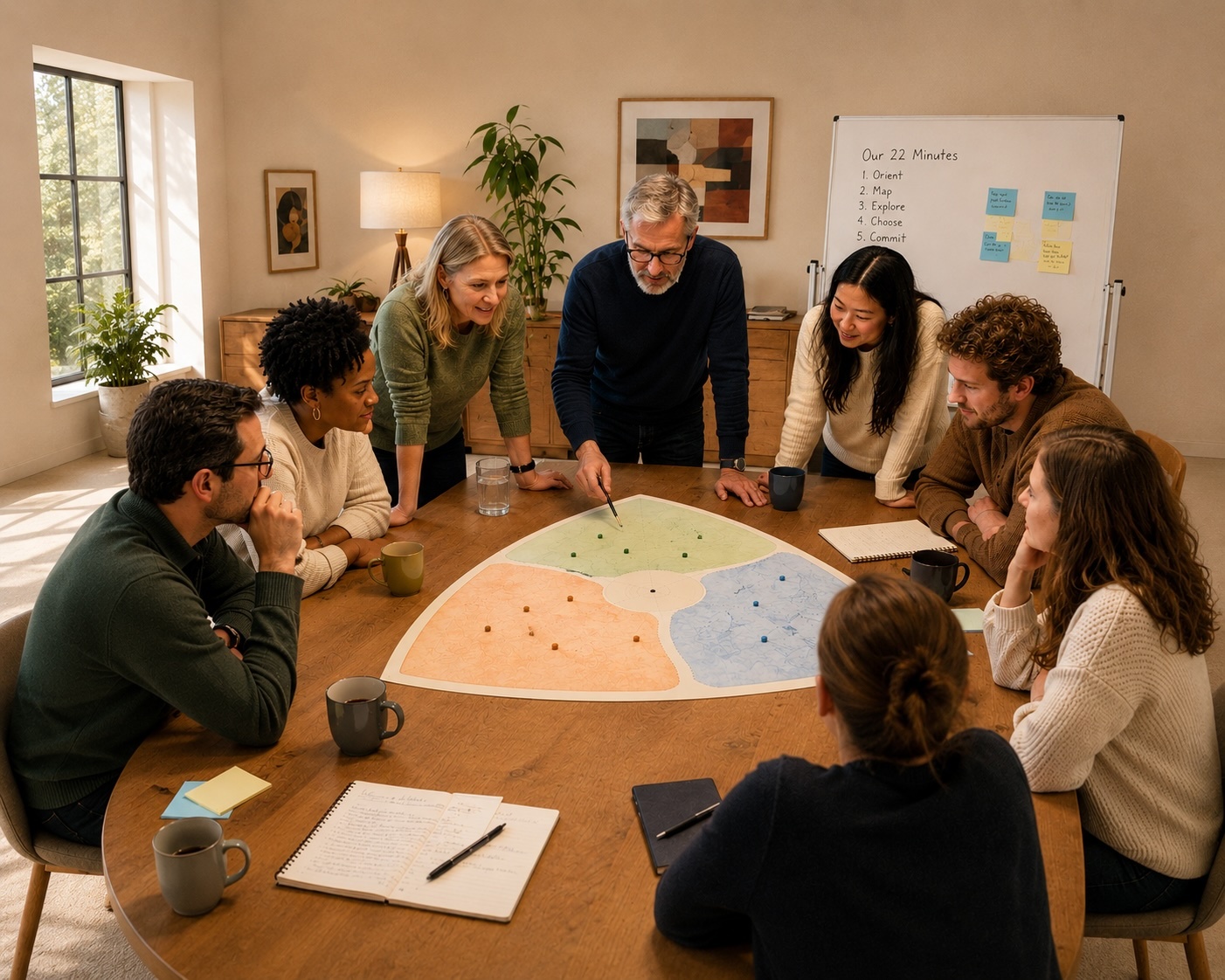
I built a short programme to test exactly this. The mechanism is simple. You give everyone in the room a map. The map shows how the people present relate to each other cognitively — not by personality, not by rank, but by the way each person naturally approaches a problem: the thinking that looks back to reduce uncertainty, the thinking that organises toward stability, the thinking that reaches forward into what is possible. Three orientations, present in every human mind, visible on a single shared image.
You do not ask anyone to declare themselves. You show the map, let each person locate their own position privately, and then — this is the part that matters — you show your own. As the person running the session, you put your dot on the map and say something brief and honest about what it means for the way you work. You are not asking for vulnerability from the group; you are offering it first.
What happens in the room in those minutes is not dramatic. Nobody weeps. Nobody has a revelation. But something quieter occurs: people begin to see that the reason they disagreed last Tuesday was not because the other person was difficult, or wrong, or not listening. It was because the other person was standing in a different part of the map. The disagreement had a shape. And that shape had nothing personal in it.
What a tool does that a facilitator alone cannot.
When the facilitator says I think you two are working from different assumptions, the room hears one person’s opinion. They may accept it; they may resist it; at some level they are being asked to take the facilitator’s word for something. When a map says it — when a scientifically grounded image of the group’s thinking shows the same pattern — the room sees it for themselves. It stops being the facilitator’s read. It becomes the room’s shared reality.
This is why tools have always mattered in facilitation, long before anyone said the word AI. A good diagnostic, a well-designed visual, a framework that has been tested — these are not crutches. They are the means by which the facilitator moves from advocate to guide. An advocate needs to be believed. A guide simply points.
What has changed in recent years is not the principle but the capability. The maps have got better. The patterns they can surface are more detailed, assembled more quickly, described more precisely. A cognitive reading of a team that once required a skilled professional several hours to produce and land in a room can now arrive in minutes, complete enough to show not only where people stand but where they tend to collide, and why. The diagnostic work that used to occupy the whole first half of a session can happen before the room fills.
The tool hands the room a shared language. The facilitator teaches the room to speak it.
Which means the first act is shorter. Not because it matters less, but because the tools have learned to do their part of it faster. A shorter first act is not a lesser one. The psychological safety it produces is the same; the time freed for everything that follows is not.
What follows is still the facilitator’s domain entirely. The map can show a team that two of its members approach risk from almost opposite positions. It cannot make those two people look each other in the eye across that fact and decide to use it rather than be divided by it. That requires a person in the room with no stake in the outcome, someone who can hold the space open long enough for a real conversation to begin. The tool hands the room a shared language. The facilitator teaches the room to speak it.
The rest of the work is human.
Heffernan’s core observation holds. Groups go quiet because they have learned that speaking costs more than staying silent. Changing that calculation is a relational problem, not a data one. But the relational work moves faster, and lands more durably, when it starts with something everyone in the room can see together.
Twenty-two minutes, if the tool is good and the guide knows what they are doing, is long enough for that.
What the room does with it after is the rest of the work. And the rest of the work has always been human.
John Furey is the founder of MindTime. He has spent thirty years studying the cognitive architecture of how people decide.

