

The human dynamic underneath the work.
Do you see what I see?
By John Furey·Founder, MindTime
June 9, 2026
I have been wondering, across these six weeks, whether what I see when I watch a team is something other people see too. The wondering is older than the writing. It is older than the framework. It is the engine that drove the framework in the first place. When I watch a room of people working, I see something I do not see described in most of the leadership writing I read. I see minds attending to the work in three different ways, and the attending mattering more than anything anyone says aloud. I have wanted, for a long time, to find the words for what the leader who notices that is doing.
These six articles have been an attempt to find out whether the noticing is shared. Each week has been one piece of attention, set down in language as plainly as I know how. The cost of consensus that closes a question before it is fully opened. The yes/no ratio underneath every meeting. The altitude problem that misreads a difference of cognitive register as a difference of opinion. The friction between modes of thought as something other than personal. The shape of a team revealed by what is missing from it. Five looks at the same room from five different windows.
I do not know what these pieces have done for the readers who have followed them. I have hoped they have done something. The most I have ever been able to do with writing is set things down where someone might see them, and trust the reader to do the rest. The rest belongs to the room you are sitting in.
What this last article wants to do is name the thing I have been pointing at all along. The thing I think has been visible, in pieces, across the previous five weeks, but that has not yet been called by one word. It is what I want to ask you about. Whether you see what I see, after five weeks of pointing.
Attention is not passive.
There is a writer who has helped me understand what I have been watching. Iain McGilchrist. I came to The Master and His Emissary late, after I had already been working with the temporal framework for many years, and read it the way one reads a long-awaited letter from someone you did not realise had been writing to you. His more recent book, The Matter With Things, is even more direct in its claim. The claim runs through both. Attention is not passive. How we attend to the world determines what becomes available to us as world. The same room can be entered by two people and become two different rooms, depending on what they have attended to as they walked in.
This is not philosophy in the abstract. McGilchrist’s case rests on the brain, on hemispheric difference, on the long story of how we became creatures who can do two kinds of attending at once. The right hemisphere, in his telling, holds context and relation. It sees the whole. It is the master function, the one we developed first and the one that, when we are healthy, holds the world together for us. The left hemisphere narrows in. It grasps, takes apart, manipulates, gets things done. It is the emissary. Useful and necessary, and dangerous when it forgets its place. Both are needed. The trouble McGilchrist diagnoses, across both books and now across his life, is that we have built a culture in which the emissary has usurped the master, and the holding of the whole has become a faculty we have stopped trusting.
I do not want to push the hemispheric story further than I am qualified to push it. What I take from McGilchrist, and what I keep coming back to, is the simpler insight that attention is not passive. The act of attending makes the world. And by the same logic, the act of attending makes the room. The meeting, the team, the conversation you are inside of.
“Whatever a leader attends to, the team eventually sees. Whatever a leader does not attend to becomes invisible to the team, even when it is in the room.”
If that is true, then what the leader attends to is leadership material. Whatever a leader attends to, the team eventually sees. Whatever a leader does not attend to becomes invisible to the team, even when it is in the room. This is not a metaphor. It is a fact about how groups assemble their shared sense of what is happening.
When I watch a team, what I see is a room of people each attending to the work in their own way, and the leader sometimes, not always but sometimes, the only person in the room attending to the attending itself. To the way the room is thinking together, as distinct from what it is thinking about. Whatever capacity she has acquired by doing that is what I have been looking for the words for.
What I was pointing at.
Across the previous five weeks I have been trying to put language to something some leaders do that others do not. It is not a different role. It is the same role, attended to differently. The work of leading a team is many things at once. She orchestrates work and motivates the people doing it. The flows of work have to be managed, and so do the human interactions running through them. Direction has to be held even when empathy is what the room needs. Accountability runs up the chain to the people she herself answers to. All of these are leadership. They have always been leadership. They have also always included one strand that has been mostly absent from the writing about it. The human dynamic of how the team thinks together. Every leader is already working with that dynamic. The question is whether she is doing it consciously.
I have a sentence I have used, mostly to myself, when I have been trying to say what leadership of a thinking system actually is. I do not know if it will land for you. Here it is.
Leadership is the conscious use of unconscious mental energy. The collective’s.
Three things in that sentence are worth taking apart, because each of them has been doing work across these six weeks without being named.
The unconscious mental energy is the part the series has been making visible. The patterns of attention that run underneath what gets said. The yes/no ratio. The altitude at which the conversation is happening. The friction between modes of thought that is misread as personal. The shape of who is in the room and who is not. None of this is exotic. It is the cognitive substrate of every team meeting that has ever happened. It is mostly invisible to the people inside it. That invisibility is the unconscious part.
Conscious use is not what most people might assume when they hear those words. The temptation is to read it as suppression, or redirection, or as the leader replacing what is already in the room with something she prefers. None of that is what I mean. Conscious use is shaping the use of what is already in the room. Not adding new energy to a team. Working with the energy that is already running.
The collective’s is the part that may matter most. The leader is not being asked to use her own mental energy more consciously. She is being asked to attend, consciously, to the energy of the team. That is a different kind of work. The energy belongs to the team. The consciousness belongs, when the work is being done well, to whoever in the room has taken on the holding of the whole. Usually that is the leader. Not because she is more capable. Because the role she occupies is the one that asks for it.
This is not a new role I am asking you to take on. It is the role you already have. The reading I have been offering across these six weeks is meant to put words to a layer of that role that has often been beneath the layer where most of the writing about leadership stays. The orchestrating, the motivating, the work flows, the empathetic direction, the accountability up the chain, all of that is leadership. The thing underneath, the thing that runs through all of it, is the human dynamic of how the team thinks together. You have been leading it all along, in whatever way the day-to-day has asked of you. The question I want to leave you with, before the next movement, is whether putting words to it changes the doing of it. Whether the doing of it consciously is different from the doing of it without the words.
What I have watched leaders do.
I want to tell you what I have watched leaders do who I think have been doing this work, whether or not they had words for it. None of these moves were taught to them. They came from somewhere older, from a practical reading of the room that they had developed by paying attention over years. I list them as observations. They are not a method, and I am not interested in turning them into one. If you have seen leaders do them, or have done them yourself without quite calling them anything, you will recognise the moves.
The first move is naming the dynamic in the live moment. I have watched a senior manager catch the moment when one person was reaching forward into a possibility and another was reaching for a foothold to ground it, and say something like: we are in altitude friction here. Let’s stay in thin air for a few more minutes before we ground the idea, because the idea is not yet ready to be held. The meeting did not stop. Nobody felt corrected. The two people who had been chafing at each other became, in a single sentence, two people doing different and complementary things, neither of them wrong. The dynamic that had been invisible became a feature of the conversation rather than a friction in it. The work continued.
The second move is calling in the missing voice. A leader I have observed says, late in a strategy discussion, we have not heard the Past-leaning question yet. What is it? What is the question that has not been asked? She did not ask if anyone disagreed. She did not call out a specific person. She named the function the conversation was missing and made room for whoever in the room could speak from that function to do so. Someone always could. Sometimes the speaker surprised even themselves. The room became, for a few minutes, a more complete instrument than it had been a moment before.
The third move is adjusting the rhythm. Another leader, after a stretch of meeting in which a great deal of momentum had built toward a decision, says: we have moved a lot of yeses through this morning. Let’s slow down before we commit, because the no-leaning voice in the room is going to be the one we will need most three months from now. The decision did not get blocked. The decision got given the time it deserved. The leader did not have to know what the dissenting view would be. She had to know that it had not yet had its hearing, and she had to make the room give it one.
These are not workshop moves. They happen in the middle of the work, by the person who has the most at stake in it getting done, while the work is getting done. The leader does these things while also orchestrating the agenda, holding the direction, managing the relational temperature of the room, and remembering that she has to report on this conversation in twenty minutes to someone above her. She is inside the frame. She has history and stakes. The forgetting under pressure that everyone else has, she has too. The discipline is to do this work anyway, alongside everything else the role asks of her, in motion, daily.
I am not pretending it is easy. It is not. What I am saying is that I have seen it done, and seeing it done has been one of the things that has convinced me the framework I have been working with for thirty years describes something real.
A sentence and a question.
What I have wanted to leave you with is a sentence and a question.
The sentence is the one I have used to myself for years. Leadership is the conscious use of unconscious mental energy. The collective’s. I have tried, in this last article, to set down what I mean by it as plainly as I know how. Whether it is the right sentence I am not the one to say. I have lived with it long enough to know that it does something for me when I am watching a team and trying to understand what I am seeing. It gives me a place to stand. Whether it gives you one is a question I cannot answer from where I sit.
The question is the one I have been circling for six weeks.
Do you see what I see?
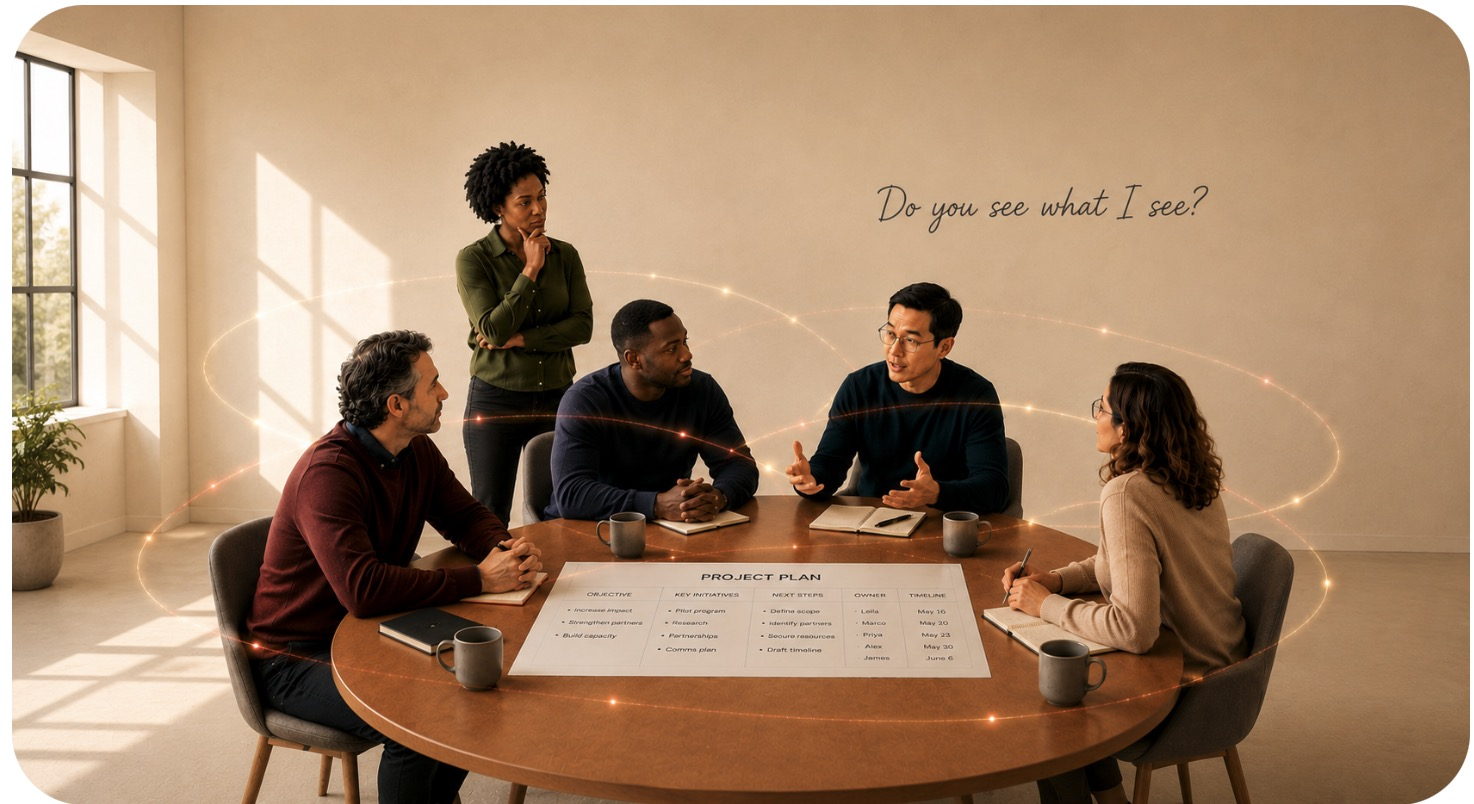
When you walk into a meeting on Tuesday morning, do you see, underneath the agenda and the deliverables and the personalities, the human dynamic of how the people in the room are thinking together?
Do you see the rhythm of their attending? The shape of what is in the room and what is not?
Do you see the forward tilt, the backward tilt, the altitude at which the conversation is moving?
Do you see the voice that has not yet spoken? The function that is not in the room at all?
If you do, then you know more than I do about whether what I have been pointing at is real, because you are inside the room and I am only inside the language. The framework is mine. The room is yours. The test of the framework is whether it gives you anything you can use when you are inside the room and the room is moving.
“The framework is mine. The room is yours.”
If something in the conversation has begun to be visible to you that was not visible six weeks ago, then the words have done their work, and the rest is yours to take into the daily flow of leading the people you lead. Disagreements that used to feel personal may begin to read as cognitive. Decisions that used to get made by the loudest voice in the room may begin to leave space for the quieter voice that has been holding the validating question. Innovation that has been idling may find traction in the friction that used to slow it down. These are not promises. These are things I have watched happen, in teams whose leaders began to read the room with new vocabulary.
The light, if it has come on for you, came on because you turned your own attention to it. The articles set out to switch the light on for some leader, somewhere, whose mind was already moving in this direction and only needed the words. If you are that leader, the words are now yours. The room you walk into on Tuesday morning is the same room. You will be in it differently.
“The room you walk into on Tuesday morning is the same room. You will be in it differently.”
That is the most a writer can hope for. That is what I have hoped for, across these six weeks.
John Furey is the founder of MindTime. He has spent thirty years studying the cognitive architecture of how people decide.
Week Six of Six · A Series for Team Leaders

