

The altitude problem.
Why your strategy meeting and your operations meeting are not actually about the same thing.
By John Furey·Founder, MindTime
There is a moment in many team meetings that almost no-one names for what it is.
Someone is still opening a question. The thought is not yet ready to commit to a form. The speaker is testing language, sketching an implication, holding the idea in suspension to see what shape it wants to take. Someone else, listening, hears a foothold and reaches for it. So what are we doing about that? Who owns it? By when? The first speaker feels a clamp come down on the thought before it has finished forming. The second speaker feels the first refusing to do the work of actually deciding.
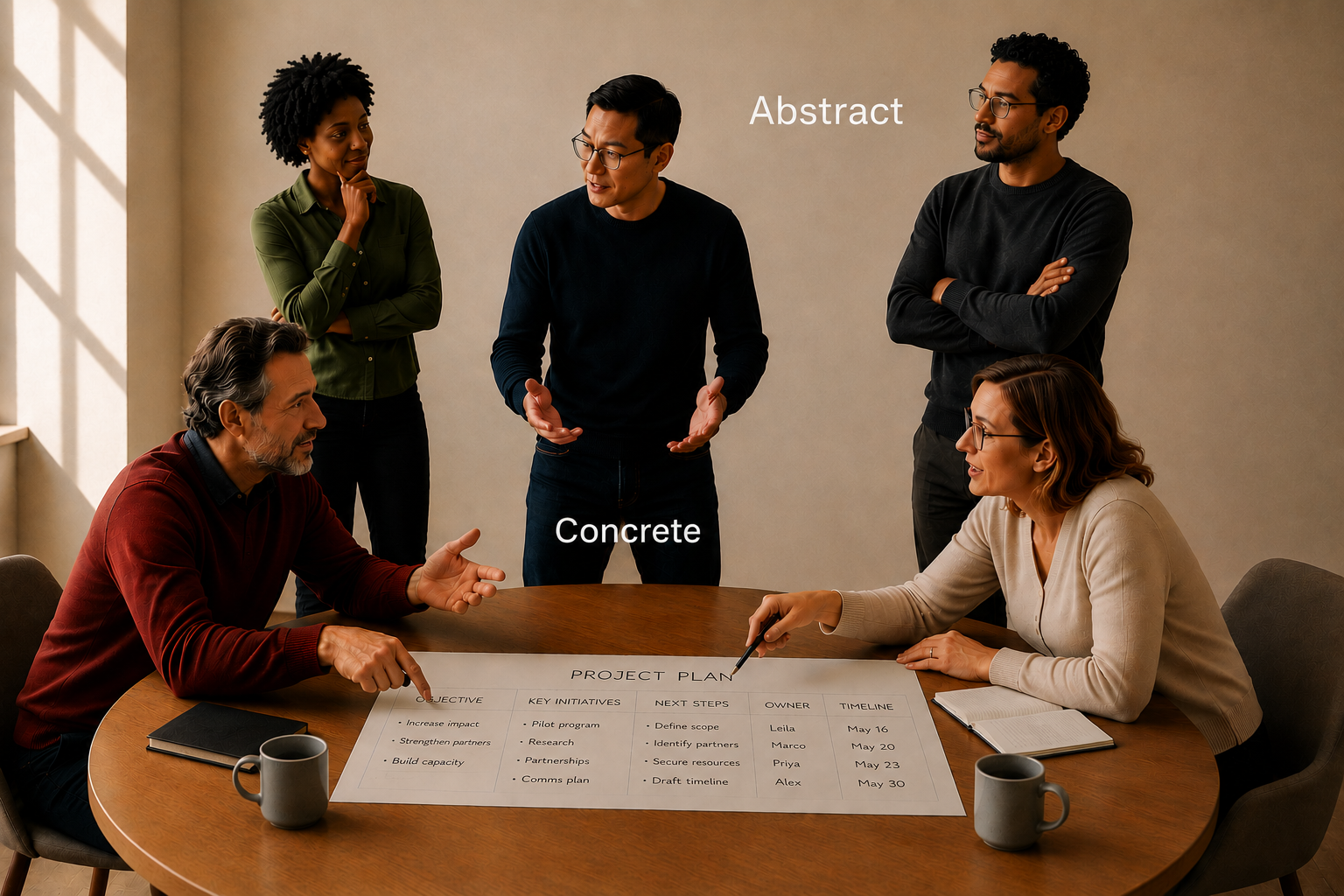
Both readings are partial. What is actually happening is that the two people are operating at different altitudes, in the same room, at the same time. The friction between altitudes is being misread, by both of them, as friction about content.
This is one of the most expensive misreads in team work, and it is one of the hardest to see from the inside.
The two altitudes.
The word altitude needs some care here, because the usual associations carry the wrong meaning.
By altitude, this article does not mean two different levels of seniority, or two different levels of strategic thinking in the hierarchical sense the word usually implies. The reference is more literal — the way a climber means it. At altitude, the air is thin. At sea level, the air is dense. At the bottom of the ocean, denser still. The same body, the same lungs, behaves differently depending on the medium it is moving through.
Some kinds of thinking happen in thin air. Some kinds of thinking happen on the ground. The thinking is not better or worse for where it sits. It is operating in a different density.
Future and Past thinking, in the MindTime framework, both operate in the thinner air of abstraction. Future thinking reaches forward, toward what is emerging, toward patterns that are not yet visible to anyone in the room. It speaks the language of possibility. Past thinking reaches backward, toward what has been verified by data and precedent. It speaks the language of evidence.
Both registers may sound concrete. A scientist describing a molecule and a strategist describing a market shift can both produce sentences full of specific nouns. But notice what is being done. The scientist is pointing at a category of thing, not the thing in front of her. The strategist is pointing at a movement she has inferred from a hundred small signals, not at a decision anyone has yet made. The reference is abstract even when the vocabulary is precise.
Present thinking does something different. Present thinking takes the abstraction and brings it to ground. It makes it real. It schedules the work and assigns it, and gives the work an owner and a milestone. The job of Present thinking is not to think in the present moment, as people sometimes assume. The job of Present thinking is to stabilise the present moment by planning the path through it. To take whatever the team is reaching toward and convert it into something that will actually have changed because of action taken in real time.
This is the altitude difference. Future and Past breathe the thin air of what could be and what has been. Present breathes the dense air of what is being done.
What this sounds like
in your meeting room.
If you sit in team meetings often enough, you will start to hear it.
Someone will be talking about a possibility. They will be opening the question, suggesting an angle, mentioning a connection to something they read or saw or noticed. Someone else will be listening with visible patience, waiting for a foothold. As soon as the foothold appears, a name or a number or a date, the second speaker will reach for it and try to use it. So if we did that, would it be a six-month pilot or twelve?
The first speaker, the one who was opening a question, will often find this jarring. The question was not yet ready to be answered. The thought was still forming. The second speaker was not being aggressive or impatient; the second speaker was doing exactly what their cognitive register is built to do, which is to take what is being said and find a way to make it operable.
This dynamic plays out in countless meetings every week, in organisations of every kind. From the Future-leaning side, the Present-leaning move feels like a clamp coming down on a thought before it has finished forming. From the Present-leaning side, the Future-leaning move feels like a refusal to commit, an avoidance of the work of actually doing something.
Neither read is wrong, exactly. Both are partial. What both sides are missing is that they are not in disagreement about the substance. They are operating at different altitudes, and the friction between altitudes is being misread as friction about content.
Why the misread is so expensive.
In any team, this dynamic compounds quickly, and it compounds in a particular direction.
The Present-thinking voice has a structural advantage in meetings. Present thinking produces sentences that look like decisions, deliverables that look like work, the kind of output that can be written down and tracked and ticked off afterward. By the end of the meeting, the page has actions on it, and the actions were almost all produced by the Present-leaning mind in the room.
The Future-leaning and Past-leaning voices, by contrast, have produced something less easy to capture. They have opened questions and surfaced concerns. They have sketched a possibility that does not yet have an owner. These contributions are real, and often more consequential than the actions on the page, but they are harder to write down and so they tend not to make it into the record.
Over months, this asymmetry becomes the culture. The team learns, without anyone deciding it, that the meeting belongs to the altitude where things get concretised. The thinner-air contributions become preamble. They become the stuff that happens before the real work of the meeting begins. The people whose minds work in thinner air begin to wonder whether they are slowing the team down. Some of them start staying quiet. Some of them leave.
What the organisation loses is not visible. It is not a decision that went wrong. It is the texture of decisions that never got the air they needed before being grounded.
The error is not Present thinking. The error is the premature move to ground.
What Present thinking
is actually for.
A reading of the previous section is easy to slip into: Future thinking good, Present thinking bad. That reading is itself a Future-leaning misread of the dynamic.
Present thinking is what allows an organisation to exist. Without the move to ground, the meeting produces nothing. The strategy paper does not get written, the budget does not get approved, the new programme does not get launched, the timeline does not get held. Present thinking is what makes the change real. It is the altitude at which the world actually changes shape.
The error is not Present thinking. The error is the premature move to ground. The move that happens before the abstraction has finished doing its work. The Present-thinker’s question — who owns it by when — is the right question. It is the right question in the right place. Asked five minutes before the thought is ready, it stops the thought. Asked five minutes after the thought is ready, it carries the thought into the world.
The leader’s task is not to choose between the altitudes. The leader’s task is to know which altitude the team is in at any given moment, and to know when the room needs to descend or to climb.
A small exercise.
In the same spirit as the yes/no exercise from last week, what follows is something you can listen for in your next meeting.
Watch for the moment when the conversation moves between altitudes. It will move. Most meetings move several times.
Notice who in the room makes the move down to ground. Who reaches for the date, the deliverable, the owner. Notice who in the room makes the move up to air. Who pulls the conversation back into the question, the implication, the underlying assumption. Notice whether the moves are well-timed, or whether some of them are happening too early, before the altitude has done its work.
If you find that almost all the moves are downward, toward operationalising, your team is likely losing its thin-air thinking before it can produce anything. The meeting feels productive. The team is making decisions on incomplete thought.
If you find that almost all the moves are upward, toward opening, your team is likely thinking beautifully and shipping nothing. The conversation feels rich. The world is not changing.
If you find the moves are roughly balanced, and the team can hold the altitude it needs for the work in front of it, you have something rare. Pay attention to how it is being held, because the holding is the work.
What this leaves us with.
The friction between altitudes is not a problem to be eliminated. It is the substrate of how a team thinks together. The team that suppresses one altitude in favour of the other does not become more efficient. It becomes less of a team.
The job is to make the altitudes visible to each other. To let the room know, we are in thin air now, and we are going to stay here for another twenty minutes before we descend. Or, we are on the ground now, and the thinking we needed is done. The leader who can name the altitude the room is in has given the room the most useful instrument in their possession.
Next week this series will turn to what happens when leaders try to do this in the open, with the team present. When the naming of dynamics stops being a private skill the leader holds, and becomes a shared awareness the team learns to hold together, the team enters the territory of Whole Thinking. This is the work the rest of the series builds toward.
For now: in the next meeting, listen for the altitude. Listen for the moves between them. And before you reach to make a move yourself, ask the question worth asking of yourself first. Is this thought ready to come to ground, or am I bringing it down too soon?
John Furey is the founder of MindTime. He has spent thirty years studying the cognitive architecture of how people decide.
Week Three of Six · A Series for Team Leaders

