

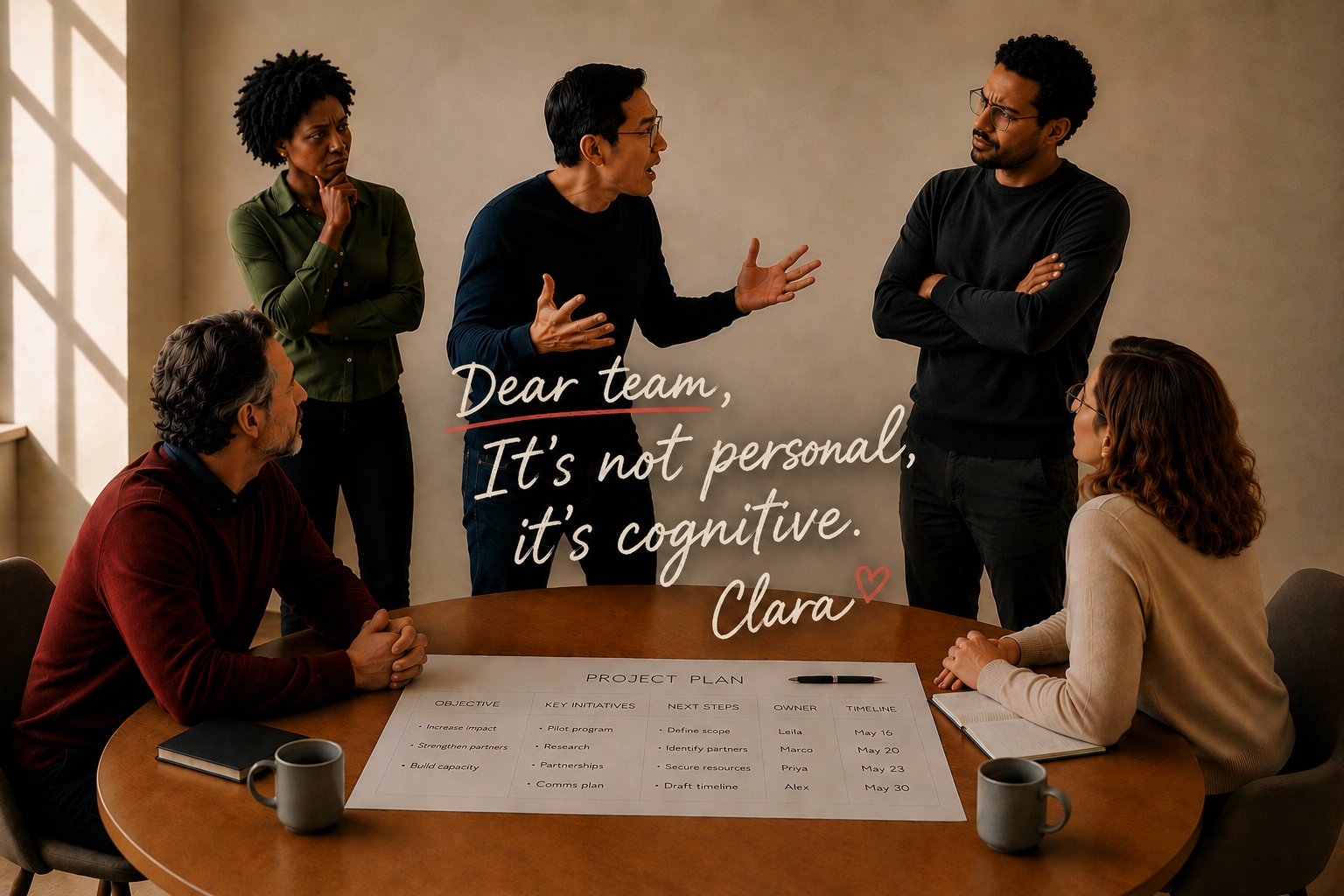
Team friction is not personal.
It’s cognitive.
What to see when two of your people cannot seem to work together.
By John Furey·Founder, MindTime
There is a particular kind of difficulty that every leader of a team eventually meets, and very few have language for.
Two of your people cannot seem to work together. You have watched them in meetings. Neither is unreasonable. Both are competent. Both, when you speak to them alone, describe the other in terms that are almost mirror-images — too cautious, too impatient, never wants to commit, never wants to slow down — and each describes themselves as the one trying to keep the work honest. You have tried the conversations a manager is supposed to try. You have surfaced what you could surface. The friction returns the next week, in a different meeting, about a different decision, with the same texture.
What is happening is not personal, though it has come to feel personal. It is also not a problem of communication, though it has come to look like one. What is happening is that two different modes of thought are pressing on the same decision, and neither has been given a name. Without a name, the difference between them becomes the difference between them. The cognitive friction becomes interpersonal friction, and the cost begins to accumulate where it always does — in the quieter voices, the withdrawn contributions, the slow loss of the team’s ability to think together about anything that actually matters.
Over the past three weeks this series has been teaching a particular kind of seeing. In week two it introduced the Yes/No dynamic — the ratio of yes-leaning to no-leaning moves in a team’s conversation, and what that ratio reveals about whether the team is using both halves of its instrument or only the half that has been given permission to speak. In week three it introduced the altitude problem — the abstract-and-concrete dynamic, in which the same five people in the same room are operating at two different cognitive elevations, one in the thin air of strategy and testing of assumptions, the other on the ground of implementation and what works in real time. Both dynamics are real. Both are visible, once the leader knows what to listen for. And both are structural — they arise from the architecture of how minds organise themselves around shared work, not from personality clashes in disguise.
This week the seeing turns outward. The skill stops being something the leader holds privately, used to manage the team from a slight remove. It becomes something the team itself acquires, used to manage itself.
That shift is what this article is about.
Thinking, not thinkers.
Here is the move that most often goes unmade when leaders try to address this kind of friction.
The language reaches, naturally, for people. She is a future thinker. He is past-leaning. They are an abstract type and that other one over there is concrete. The vocabulary feels useful because it appears to explain. It gives the friction a location — in this person, in that person — and a location feels like a step toward a solution. If the friction lives in two people, then the work of the leader is to manage those two people. Coach the one. Coach the other. Find the meeting room where they can sit far enough apart.
This is the wrong frame, and it is wrong in a specific way worth being precise about.
The three orientations — toward the past, the present, the future — are not types of people. They are modes of thought. Every mind, including yours and including each of the minds at your table, contains all three. What varies between people is the proportion. One person’s attention rests more naturally in the not-yet, scanning forward for what could be. Another’s rests more naturally in the already-known, scanning backward for what has been proven. A third stays close to the breathing surface of the present, attending to what is workable now, under actual conditions. These are not boxes you are placed in. They are weather patterns in the mind, with prevailing winds.
The reason this distinction matters is not philosophical. It is operational.
When a leader treats the friction as a clash between two kinds of people, the work becomes interpersonal management, and interpersonal management, in the long run, is exhausting and rarely successful, because the leader is trying to manage something that is not actually located where they are looking. The two people are not the problem. The two modes of thought pressing against each other are the dynamic. The same dynamic would arise if you replaced both people tomorrow with two others who carried similar cognitive weather. The friction is not in the personalities. It is in the room, in the conversation, in the work itself.
This is the reframe the rest of the article rests on. The friction your team experiences is the friction of thinking happening in real time, unevenly distributed across the people present. It is the visible surface of a deeper architecture. When the leader can see this clearly, and more importantly when the team can see this clearly, the entire character of the team’s conversation about itself shifts. Blame loses its grip. The language stops being you and your problem and becomes the thinking and what it needs.
That shift is the precondition for everything that follows.
A discipline of attention.
The shift the leader is being asked to make is not a technique. It is closer to a discipline of attention.
Every team is doing its thinking together, all the time, whether it knows it or not. The conversations in the strategy meeting, the disagreement about the timeline, the moment when one person goes quiet — these are not separate events. They are the team thinking. They are the team’s collective mind at work, three vectors of attention pulling on every question that comes through the door, sometimes in harmony, sometimes not. Most teams are unconscious of this. They experience their thinking as a sequence of meetings and decisions and follow-ups. They do not yet have the language to see the cognitive process beneath the meetings, the decisions, the follow-ups.
The leader’s task — once they have learned to see the dynamics themselves — is to make the team conscious of its own thinking. Not in a clinical sense. Not by running a workshop. By naming, in real time, in the room, with the team present, what is happening cognitively beneath what is happening conversationally. We have been at altitude for forty minutes, and I notice we have not yet brought it down to land. The Yes-leaning voice in the room has been carrying this conversation for the last ten minutes, and I want to hear the No-leaning voice before we commit. We are at a point where the abstract question has not yet matured, and I want to stay with it a little longer before we move to action.
The first time a leader does this, it feels unfamiliar to everyone, including the leader. The second time, less so. The fifth time, the language has started to belong to the room rather than to the leader, and one of the quieter people in the team has begun to use it themselves — I think we are at altitude and not landing. From that moment forward, the skill is no longer the leader’s possession. It is the team’s.
The naming is not a neutral act, and the article would be dishonest to suggest otherwise. The Yes/No dynamic, in particular, is almost always the place where the team’s historical conflict has lived — because it is where Future-leaning attention, reaching for what could be, meets Past-leaning attention, testing against what has been proven. That meeting, performed without language, has often produced exactly the kind of friction the leader is reading as a personality clash.
What is actually happening in that meeting is more delicate than the friction makes it look. A future-leaning voice puts an idea into the room — a partnership that could be struck, a programme that could be launched, a direction the work could take. The past-leaning attention in the room then chooses, in the moment, what to do with the idea. It can foreclose. We tried that. It didn’t work. That will never fly here. And the future-leaning voice will defend, retreat, or stop offering. Or the past-leaning attention can inquire. How would that actually work? Is this like the thing we tried last year, or something different? What would have to be true for this to land? And the future-leaning voice will open, elaborate, refine the idea against the questions. The trust is being built in real time, in the exchange itself — in the texture of the listening, in the choice between curiosity and judgement.
This is the conversation the leader needs to step into and name. The move has three parts, and they happen quickly when they happen well. The leader names the dynamic — we are in the Yes/No conversation right now. The leader assigns it value — this is not a problem. This is the team’s reaching-forward attention meeting its testing-against attention, and we need both, because without the reaching-forward the idea is never born, and without the testing-against it is never made real. And the leader promotes the conversation — I want to hear the questions the testing attention is holding right now, asked as questions rather than as conclusions, because that is how the idea gets stronger rather than shut down.
The first time a leader does this, both the future-leaning and the past-leaning people in the room may be startled. Each of them, for the first time, is hearing the work they have been doing for years given a name, and the name is being assigned value. That moment — the startled silence, followed by the careful re-entry into the conversation — is the moment the trust starts to be built.
“This is Whole Thinking. The team’s awareness of itself as a thinking system — and the agent of its own evolution.”
Whole Thinking is not a sequence to be performed. It is not Future first, then Past, then Present, in any prescriptive order, though those movements do occur naturally in healthy teams and will become visible to a leader who has learned to watch for them. Whole Thinking is the team’s awareness of itself as a thinking system — the meta-cognitive capacity of the group to notice, in real time, whether it is using all of its mind or only a portion of it, and to course-correct when it is not.
The team that achieves this becomes the agent of its own evolution. The leader who builds it is no longer doing private cognitive management on behalf of people who cannot do it for themselves. They are working alongside a team that can think about its own thinking — that can say, in the middle of a meeting that has begun to stall, we have lost the Past-leaning attention here, can we hear from the person who has been holding it? — and the team that can do this is a different team than the one that cannot. It carries a different kind of trust. The trust is structural. It is built into how the team understands itself.
What it costs
not to do this.
It is worth being precise about what happens on a team that has not yet built this awareness, because the cost is borne unevenly, and the unevenness is structural.
Picture a leadership team of six. Four of them carry strong Future-leaning attention as their dominant posture. One carries strong Present-leaning attention. One carries strong Past-leaning attention. The four Future-leaning voices generate ideas easily and quickly, building on each other, finding partnerships in each other’s thinking. The Present-leaning voice translates the ideas into the question of what would actually have to happen on Monday for any of them to work. And the Past-leaning voice — the one — holds the testing function. The asking of have we tried this, what did we learn, what are we forgetting that we already know.
Watch what happens to that one Past-leaning voice over six months, in a team where Whole Thinking has not yet been built.
The first time they ask their questions, the room responds — four future-leaning voices, accustomed to each other’s company, experiencing the question as an interruption to the building momentum of the idea. The response is rarely hostile. It is more often quick. Yes, but this time is different. We have thought about that. Let’s not get into the weeds. The Past-leaning voice asks again, slightly less assertively, in the next meeting. The same thing happens. By the third meeting they are choosing their moments more carefully. By the sixth, they are asking less. By the tenth, they have stopped offering the testing in the room and are doing it privately, in their notes, or to one trusted colleague after the meeting has ended.
What the team has lost, at that point, is not a person. The person is still there. What the team has lost is the testing function — the capacity to notice what it already knows about ideas it is excited about — and the loss is invisible to the team, because it has been replaced by the smoother, faster, more agreeable conversation of four Future-leaning voices who experience the room as having become more aligned.
The cost is paid by the Past-leaning person, who carries the experience of being slightly outside the room even when present in it. And the cost is paid by the team, which is no longer thinking with all of its mind.
What this leaves us with.
What this article has tried to do is name a shift.
The first three weeks of this series taught the leader to see. The Yes/No ratio, made audible by simple counting. The altitude problem, made visible by attending to where the conversation actually was. Two real dynamics, both structural, both available to any leader willing to listen with the right kind of attention. Held privately, in the leader’s own perception, those skills are already valuable. They allow a leader to manage a team with more clarity than they had before.
This week the proposal has been larger. The skill, held privately, is the beginning. The skill, given to the team, is the work. When the leader names dynamics out loud, in the room, with the team present, and when the leader is willing to step into the conversations that have historically produced the most friction, and to assign those conversations their structural value, the language stops belonging to the leader alone. Over time, it belongs to the team. The team that holds this language is a different kind of team. It can notice itself. It can course-correct. It can do its thinking with all of its mind, not only with the parts that have so far been given permission to speak.
That is Whole Thinking, in the form that matters.
The team described in the previous section — four Future-leaning voices, one Present-leaning, one Past-leaning — is not unusual. Teams arrive in this configuration often, particularly when they have been built around a founder, an executive, or a small group of original thinkers whose own attention reaches strongly forward. The Future-leaning posture is what brings new work into existence. It is also what, unchecked, produces a room that has not yet learned to test what it is building. The question this raises is the one I want to take up next week. What does it actually mean when a team has no member who leads with one of the three modes of thought, or only one member who leads with, say, Past? Is that a problem? When is it a problem? And what does the leader do about it? Those are the questions of the vital and missing links. They are the next chapter of this work.
John Furey is the founder of MindTime. He has spent thirty years studying the cognitive architecture of how people decide.
Week Four of Six · A Series for Team Leaders

