


The shape
of your team.
When the work is no longer to read what is in the room, but to read what is not.
The question a leader eventually asks, once she has been watching her team’s dynamics for a while, is not who is difficult. It is who is missing.
She may not phrase it that way. She may phrase it as a doubt that the conversation in the room never quite tests itself. Or as a feeling that the team has all of the pieces and still cannot deliver in any coordinated way. Or as the recognition that the innovation engine, which she has built carefully and staffed with bright people, idles. None of this looks like absence on a personnel chart. The seats are filled. The skills are present. The people are good. And yet something is not in the room.
That something has a shape. It is the shape of a particular mode of thought that the team is too thin in. It does not announce itself, because absence rarely does. The team feels its absence as friction, or as a quiet drag on momentum, or as the strange experience of watching a plan move forward without anyone asking the question the plan would fail without. The leader feels it as the sense that she is the only one in the room thinking a certain way. She is uncertain whether that makes her right, or simply alone.
The previous four articles in this series have been about reading the live cognitive dynamics of a team, what is there. This article is about reading what is not.
What about your team.
Take a moment with these questions. Not as a quiz. As a calibration.
Have you noticed that ideas in your team rarely meet pushback? You used to read that as alignment. Lately you have begun to wonder whether it is something else — a quiet that should not be there.
Have you had the experience of watching the team agree on a plan that you yourself were not yet sure of, and finding no-one in the room willing to slow the agreement down?
Have you felt that the team has all of the pieces, strategic, operational, technical, relational, and still cannot bring them together into delivery that holds?
Has the work of innovation in your team begun to feel like an engine idling, competent, technically running, moving nothing?
Does it feel, when you walk out of the meeting, that the team has talked but has not tested?
If any of those questions land, the team you lead may have a shape that is missing a vital link. That is what this article is about.
The map.
What follows is a map of an actual team. Four members. Their cognitive positions plotted on the field this series has been working with from the start: Past, Present, Future, the three modes of thought a team thinks in.
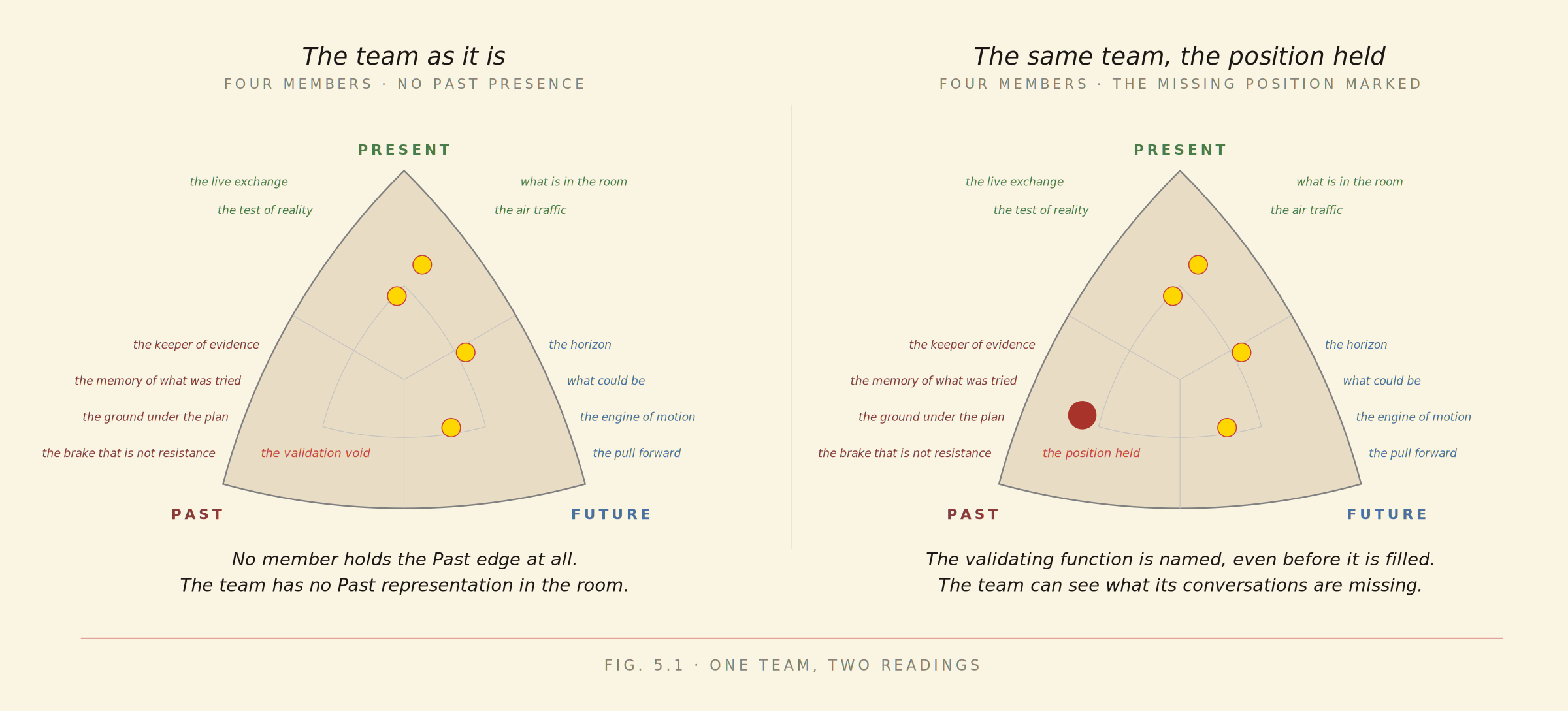
The red mark on the right map names the position the team needs to recognise is missing. How that position eventually gets held is a choice. The leader can hire for it, bringing in a Past-dominant voice and onboarding them with the whole team participating, so the new member lands already in conversation. The leader can borrow it: a peer, an advisor, a board member temporarily holding the function while the team learns what it has been missing. Or the leader can hold it herself, making space, in every conversation, for the question no-one else in the room is leaning into. The first is a hire. The second is a loan. The third is a practice.
Look at the left map first. The team’s centre of gravity sits in Present and Future. All four members cluster in that arc. None of them holds the Past trisect. Not lightly, not at the edge. The Past region of the map is empty.
This is what a vital missing link looks like in practice. Not the version where one Past-leaning voice is doing the validating work alone, lightly, and getting drowned out. The version where the function is not in the room at all. The team has no member whose first instinct is to reach for what is already known — for the evidence, the precedent, the prior attempt, the institutional memory of what has been tried and what happened when it was tried. The reaching does not happen, because no-one in the room is calibrated to do it. The conversation moves toward what is next, and nothing in the conversation pulls it back toward what is.
A team with no Past presence has no Past gravity. There is no centre of weight that pulls the conversation toward evidence, toward precedent, toward the question of how the present plan stands against the team’s own history. The forward motion of the team is unopposed. That can feel, in the room, like clarity. It can feel like alignment. What it actually is, is a conversation missing one of its three perspectives.
What that absence does.
A team with no Past gravity moves quickly. That is the first thing you notice. Decisions get made, plans get formed, the cadence of work has the energy of forward motion. For a while this looks like health.
What it produces, over time, is harder to see. The team makes the same kind of mistake more than once, because no-one is the keeper of we already tried this and here is what happened. The team’s strategies become layered rather than corrected. New plans sit on top of unresolved old plans, and the unresolved bits become invisible operational drag that no-one knows the source of.
The team also loses the kind of pushback that is most useful: the we have tried this before pushback. Not the resistance pushback. Not the difficult-personality pushback. The kind of pushback that comes from someone in the room who carries the institutional memory of the team’s own past attempts. When that pushback is missing, every idea looks fresh. Every plan looks workable. The team’s ability to test its own ideas against its own history quietly disappears.
In the team on the left map, this is happening. There is no member who carries the institutional memory into the conversation. The team’s strategies look fresh because nothing in the room is testing them against the team’s own attempts. The plans are workable because the workability is not being checked against what worked before and what did not. The forward motion that the team experiences as productivity is, in part, the absence of any cognitive force that would slow it.
This is not a personnel problem. The four members are good. Their work is real. The problem is structural: the team has been composed for Present and Future, and no-one in the room is holding the Past function. The room cannot, on its own, generate the validating work it has not been built to do.
The right map.
Look now at the right map. Same team. Same four people in the same positions. One additional mark has been placed, deep in the Past trisect: the solid red dot. Larger than the team dots. Distinct.
That red mark is not a person. It is a position the team needs to recognise is missing. It is the validating function rendered visible, named, given a place on the map even though no-one is yet standing in it. The article is about to talk about three ways that position becomes held. But before we get to those, notice what the right map already shows. When the position is acknowledged, when the team can see what is not there, the diagnostic stops being abstract. The team is no longer a Present-Future engine running without a brake. It is a Present-Future engine that knows the brake is missing. That recognition is the first move.
Three ways the position gets held.
When a leader has read the shape of her team and seen the position that needs to be held, she has three moves available to her.
The first move is to hire. Bring in a new team member whose primary mode of thought is the missing one. In the case of this team, that would mean a Past-dominant member with a strong second in Present. Someone whose instinct is to ask what already exists, what has been tried, what the ground will not let the team do, and who has enough Present orientation to hold that conversation in the room rather than offline. This is the cleanest move when the team has capacity to grow. It is also the move where most teams stumble, because hiring for a mode of thought is not the same as hiring for a role, and most onboarding processes do not know how to integrate a new cognitive voice into an existing team’s conversation.
The second move is to borrow. The team’s leader can bring the missing function into the team’s conversations without adding to the team’s headcount: through an advisor, a board member, a peer in another part of the organisation, or a structured practice that imports the Past-leaning question into the room. This is a temporary loan of a perspective. It does not solve the structural shape of the team. It does buy the team the chance to learn what it has been missing, and it lets the leader test what changes in the team’s conversations when the function is present.
The third move is to hold the function herself. The leader becomes the keeper of the missing question. In every conversation, she makes space for the question no-one else in the room is leaning into. She does not pretend to be Past-dominant when she is not. She asks the question deliberately, knowing it is the question the room would otherwise skip. This is the most demanding of the three moves, because it asks the leader to do permanent cognitive work that the team’s composition does not naturally do for her. It is also the move that produces the most subtle, durable change in the team. The team learns, over time, that this question gets asked.
A hire. A loan. A practice. Three different ways to bring the missing function into the room.
Onboarding the missing voice.
If the leader chooses the first move, the hire, there is a piece of the work that most teams do badly. I want to name it directly.
A team that has been operating without Past gravity has been operating in a particular way. Its meetings have a rhythm. Its decision-making has a cadence. Its sense of pushback is calibrated to the absence of the validating voice. When a new member arrives whose primary mode of thought is the missing one, the team does not automatically know how to receive them. The new member tries to do the work they were hired to do, bringing evidence, bringing precedent, bringing the let us slow this down question, and the room reads them as friction. Within a quarter, the new member has either become quiet, or has begun to drift toward the team’s centre of gravity to be more easily heard. The hire has failed. The wrong person was not hired. The team did not know how to onboard a cognitive voice.
The fix is to onboard the new member with the team present. Not as orientation. As cognitive integration. The team needs to know what mode of thought the new member is bringing, why it has been missing, what conversations it changes, and how the team intends to make space for it. This is the work that the cognitive mapping conversation makes practical. When the whole team can see its own shape and see the position the new member will hold, the new member arrives into a room that is expecting them. Their time to productivity collapses, because they are not spending the first three months earning the right to be heard. They are heard from the first meeting.
This is what Team Intelligence makes possible. The platform shows the leader the shape of her team, names the position that needs holding, and gives the team a shared language for receiving the new voice when it arrives. Clara holds that conversation between sessions. The leader returns to test her reading of the team, to plan the onboarding, to track what changes once the new voice is in the room. The platform is not the move. The move is the leader’s. The platform is what makes the move legible to everyone the move affects.
What to do with the question this article has opened.
If, somewhere in the diagnostic questions at the start of this article, you recognised your own team (the absent pushback, the pieces without coordinated delivery, the engine in idle) the work this week is not to act yet. The work is to look.
Look at your team’s last three significant decisions. In each one, who reached for the evidence? Who reached for the question of how this would land on the people the decision affects? Who reached for what could be? If one of those three reaches did not happen in your team, or only happened lightly, from one or two members whose position was thin, you have the beginning of a reading of the shape of your team.
That reading is what the next article in this series builds on. Next week we move from seeing the shape to building the shape. What it means to deliberately compose a team for cognitive completeness rather than for skill coverage alone, and what changes in the leader’s own work when the question stops being who do I need to hire next and becomes what does this team need to think next.
The shape is the prior question. Everything else follows from it.
And the looking does not have to be done alone. Reading the shape of a team by eye, from memory, across a handful of meetings, is exactly the work that gets thin and approximate when a leader does it unaided. Team Intelligence is where the looking becomes precise: the team’s shape made visible, the missing position named, Clara holding the reading between sessions so it does not evaporate the moment the meeting ends. That is what the early adopter pilot exists to put in a leader’s hands.
John Furey is the founder of MindTime. He has spent thirty years studying the cognitive architecture of how people decide.
Week Five of Six · A Series for Team Leaders

