AI adoption isn’t a tech decision.
It’s a cognitive one.
McKinsey’s June paper names the right discipline for the AI era. A small experiment with three LLMs shows what the paper misses.
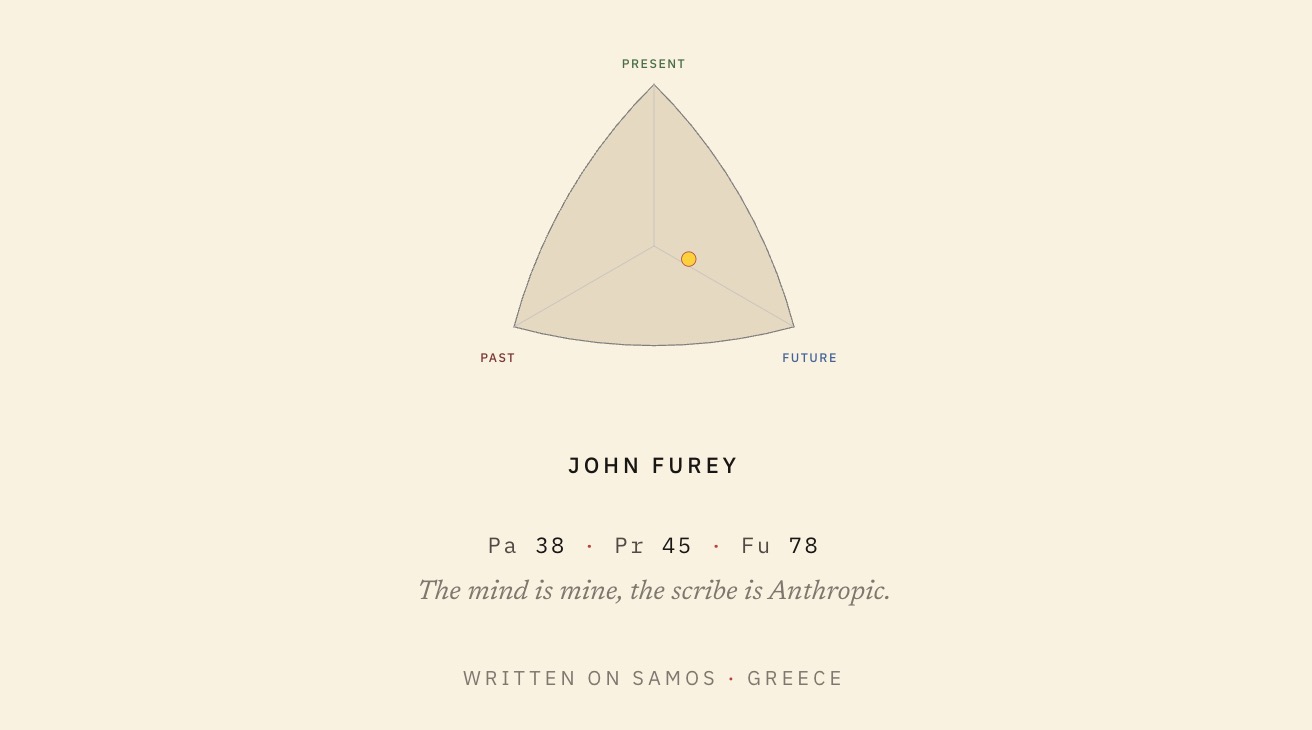
Last year I ran a small experiment that I think every team leader considering an AI rollout should sit with for a moment. I asked three large language models, Claude, ChatGPT, and Gemini, to take a cognitive inventory I have been developing for thirty years. Twenty-four items, four minutes for a human to complete. Claude took longer. It read each of the twenty-four items, paused over them, and worked through the instrument on its own. So did the others. The results were strikingly similar across all three.
Strong Past thinking. Reasonably competent Present thinking. And on the Future side, which is imagination and the liminal emergence of what does not yet exist, a real weakness. Claude was honest about it. It said, in effect, that it could in principle have been trained for that capacity and had not been.
Why am I telling you this? Why have I just revealed that I used a cognitive framework to assess the biases of the AI you are about to ask your team to use?
Because in June, McKinsey published a paper called The Symbiotic Enterprise: How cognitive and physical AI are reinventing enterprise execution. The argument is precise, the modelling careful. AI agents, intelligent robots, people. Each of the former is described with attention to what it can do, what it cannot, how it learns, how it hands off to the next system. The picture is convincing.
Then the paper turns to the humans, and the resolution collapses.
In the Venn diagram on page 18, humans occupy one circle. Inside that circle: set strategic priorities, create and innovate, build trust and relationships, govern performance, ethics, and accountability. Four functions, one undifferentiated human. The same diagram shows AI agents and intelligent robots with carefully distinguished capabilities. The artificial side has architecture. The human side has a label.
The paper itself names the discipline that ought to close this gap. Intelligence architecture engineering, McKinsey calls it. The phrase appears on page 24 as the first of five disciplines that will determine future enterprise performance. They define it as designing “how work, decision-making authority, and accountability are distributed between humans and AI agents.”
My small experiment, run a year before this paper existed, already showed where the gap sits. If we do not see the cognitive differences between the humans on a team, and if we cannot name the cognitive biases of the AI itself, we are not actually having the conversation McKinsey is asking us to have. They have named the discipline. They have skipped over the substance that would let a team leader practise it, because they do not have a working model of human cognition on which to build.
You cannot architect the handoffs between humans and AI agents without a model of the humans that renders at the same resolution as the model of the agents. McKinsey has rendered the second with care. They have not rendered the first. So the discipline they propose lacks half of what it needs.
A team of seven.
Take a team of seven. Two of them lead with Future thinking. They reach toward what is not yet here, imagining the opening—the opportunity—before there is evidence for it. Three lead with Present thinking; they execute, read the room while it is happening, hold the work together. The remaining two lead with Past thinking. They remember what worked, what failed, what the data said, and try to push to de-risk innovation and adaptation. This is a cognitive architecture, observable in any team that takes the trouble to look. Each orientation processes time differently, and each one needs different things from a thinking partner.
Now introduce AI into that team. Same model, same prompts, same training. What happens?
AI is sycophantic by default. It amplifies. Whatever you bring to it, it gives back more of the same. This is the deepest layer of the sycophancy problem and the one we rarely name.
For the Future thinker on that team of seven, this is corrosive. The Future thinker does not need her ideas celebrated. She needs someone to ask her: Nice idea, did you check this? what happens if? can you describe the actual mechanism? Future thinking does not ground itself. It needs a counterpoise, and AI, asked to react to a Future-leaning prompt, will mostly applaud.
For the Past thinker, the failure mode is different and no less corrosive. He brings AI a question grounded in precedent—what does the data say, what did we do last quarter, what is the regulatory position—and the system gives him back a confident answer that confirms his frame. He needed a provocation toward what is imaginable beyond the data. He got a louder echo of the data.
The Present thinker, meanwhile, asks AI to speed up her execution, and it does. It writes the email, summarises the meeting, builds the deck. What she needed, in many of those moments, was the lift of a wider horizon: the question of whether the deck is being built for the right meeting at all. AI compresses her loop. The horizon stays where it was.
In each case, the same tool, the same training, the same intelligence, and three different distortions, because the cognitive material going in was different.
This is the architecture inside the people. The discipline McKinsey calls intelligence architecture engineering does not see it.
Recall the experiment I opened with. The system whose deployment McKinsey is describing, the system into which we are folding the future of enterprise execution, knows its own cognitive shape and can name its own deficit. We can ask it. It will tell us. And then we hand it to a team of seven, with their two Future thinkers and three Present thinkers and two Past thinkers, and we tell everyone to use it the same way. AI can be systematically prompted to understand the person using it: to recognise their cognitive makeup, the value it brings, and how to truly help rather than simply compliment. The absence of this from McKinsey’s design is a bit astonishing. For a future-leaning piece, it is rather lacking in imagination on how AI might actually leverage cognitive differences.
What this asks of team leaders.
The implication for team leaders is uncomfortable and unavoidable. Before you architect the work between humans and AI, you have to understand their cognitive differences. You cannot intelligence-architect a team by treating the human side as cognitively homogeneous. Steel is not bronze. Past thinking is not Future thinking. The cognitive differences around the table determine what the architecture can do.
McKinsey is right that the discipline of intelligence architecture engineering will separate the winners from the rest. They have the right name for the right thing. The piece they have missed is the piece without which the discipline is not actually intelligent. It is the model of human cognition itself, rendered at the same resolution they have rendered the machines.
Until that part of the architecture is taken seriously, we will keep amplifying what we already are and calling it transformation.
How are you approaching AI integration? One size fits all? Tell me in the comments.