Field Notes
Occasional observations of the world I have been watching.
Could do better.
You + AI = Whole Thinking
I was reading David Shariatmadari’s essay in The Guardian this morning on how AI is shaping language, and it resurfaced a thought I’ve been carrying for a while. I find the AI authorship debate a bit confused, and I have been wanting to say why.
Political leaders use speechwriters. Most religious leaders do too. So do most business figures who step up to a lectern. We don’t usually call what they read out fakery. If anything, we are quietly grateful when a poor public speaker has the benefit of someone else shaping thought into sentences for them, and cringe when they go off script. The room follows more easily. The thinking lands better. That can’t be a bad thing.
So what changed?
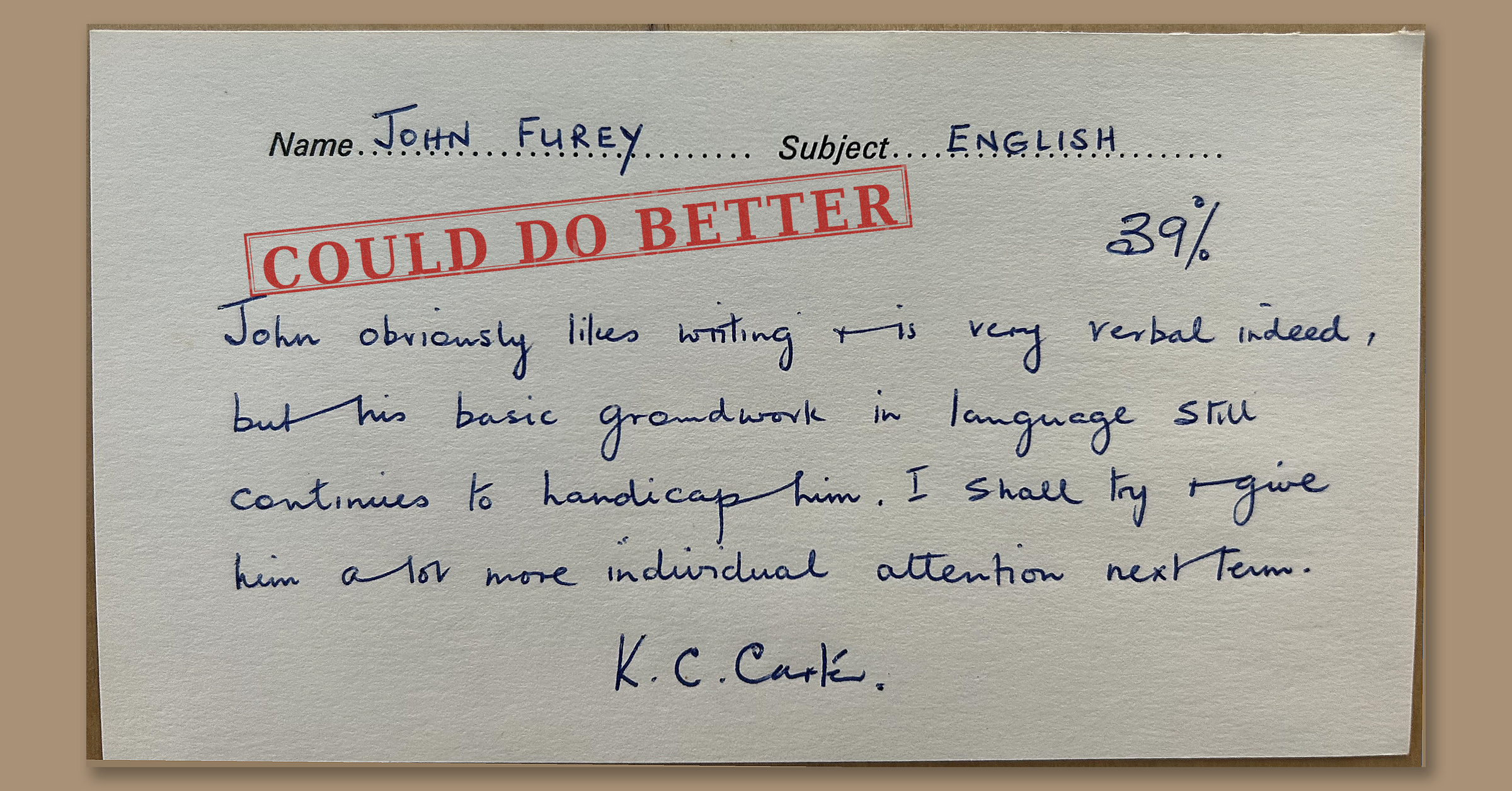
Somewhere along the way, we lost the distinction between the thinking and the writing. Between what is being said, and how it lands on the page. It feels a little as though we’ve all gone back to school, and Mr Carter is at the front of the classroom again, picking on our spelling and grammar, and quietly ignoring the ideas underneath.
Now try, if you will, to think about what it is like to grow up in a world that was more interested in your obedience to the rules of communication than in the originality of your thinking. That was my world, from 1968 to 1981 (the image I shared is from 1972). Then I bailed.
I went walkabout for a few years and ended up in the United States, where my English accent and quick thinking, the very things that had earned me low marks at home, were suddenly in demand. What a turn around. I’ve read voraciously all my life, and I hugely admire brilliant writing — John Fowles’ The Magus is the book that always comes to mind, prose that elevated me in a way I could feel. But no amount of reading could rewire my cognitive apparatus. I am a speaker, not a writer.
Ironically, for many years, people have complimented me saying I write the same way I speak. At least, it mostly sounded like a strong compliment. Maybe that was my own positive spin on it. Either way, it is true. I was never a particularly good writer at school. Articulation was fine. What tripped me up were the so-called rules. Why should writing and speaking be different, if the thinking is the same? Oh yes. The rules.
Years ago, when I wanted to write my first serious book (Power Tools: A User’s Manual for the Mind, long out of print), I brought in a brilliant young writer called Miller Stevens. I put his name on the byline: John Furey with Miller Stevens. The thinking was mine, all the many years of it. Miller’s job was to render it into a form other people would want to read. He captured my voice with real care. Was that fakery? Hardly. It was craft, added to thinking.
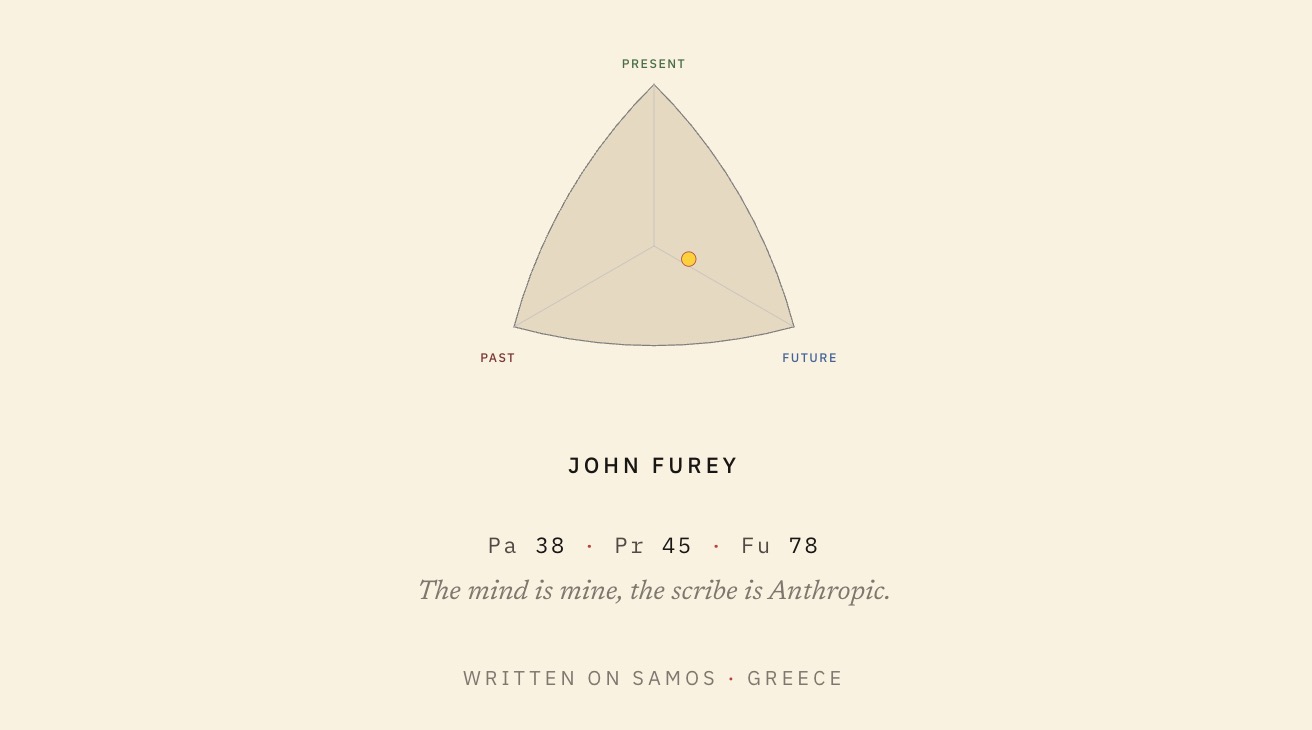
Something quite similar is happening now, and I can describe it in precise terms. My cognitive profile, using the peer-reviewed MindTime framework I’ve spent thirty years developing with Vincent Fortunato, is Past 38, Present 45, Future 78. I lead with Future thinking. Now consider Claude. I recently reran the same cognitive instrument on the model itself, it had been a year since I first did it. Claude scored Past 78, Present 64, Future 56. Claude leads with Past thinking. Same basic result as a year ago.
Consider what writing is. It is meaning-making from the accumulated record. Knowledge, structure, memory, precision. Past-thinking work, and exactly what a large language model is engineered to be strong at. That is the tool doing what the tool was built to do.
So a Future-dominant thinker collaborating with a Past-dominant scribe is, in fact, the correct pairing. My scribe has strengths I do not have. I have strengths my scribe does not have. What comes out of the collaboration is something neither of us could have produced alone.
Understand your thinking style. Use AI to complement it not compliment it. Give yourself the thinking you underweight, and see what your thinking becomes when it is whole.
Try this. Go to mindtime.com and take the free four-minute survey. Once you have your profile, open Clara, the MindTime AI, and ask her to help you write a system prompt for your favourite chatbot. A prompt that instructs the model to be a thinking partner who complements your natural style, pushes you to see what is in your blindspot while holding the modes you underweight for you. Then use it for a few days, and see whether it does not, quietly, improve the quality of your thinking.
I can tell you what happened for me. I found myself guided and gently pushed into territory I would ordinarily navigate around and avoid altogether. Evidence I would have skipped. Connections I would have missed. It felt as though I had, at last, a thinking companion guiding me through new patterns.
Shariatmadari asks Jeannette Winterson, in that same Guardian piece, whether she would ever work with an LLM. Her answer is one I would like to end on. Of course! Why not? Humans, she reminds the reader, are tool-using animals. That is our success story.
Whole thinking. That is the phrase I keep returning to. A tool, chosen well, makes the thinking more whole. It carries the parts I could not have carried alone, so that the parts I can carry get where they were trying to go.