A Sunday Thought Experiment
the cognitive approach
to team performance
The latent
image.
A Sunday piece, offered as speculation. Iain McGilchrist divided the brain by how it pays attention. I wanted to lay time across his map and watch what develops.
By John Furey·Samos, Greece
Like so many people, I have read Iain McGilchrist, and the reading stretched my imagination into possibilities I had not reached before. So this Sunday I let myself do something I would not do on a Tuesday. I let myself speculate. Call it dreaming a little.
For more than fifteen years he has made a single patient argument. The brain gives us two ways of paying attention to the world, and they do not attend to the same world. One way reaches out and takes hold. It grasps a thing, names it, makes it still enough to be used. The other way opens rather than grasps. It takes in the whole, the living context, the thing as it actually is before we have decided what it is. His warning, pressed down from thousands of pages into a sentence, is that the grasping kind was built to serve the open kind, and somewhere along the way it took the throne.
A wonderful servant, he calls it. A terrible master.
He would probably dislike what I am about to do with his idea. He divides the brain by how it attends. I want to lay a different thing across his map. I want to lay time.
Let me be honest that this is speculation, and say so before I start, because it matters. There is no brain scan that shows the future living in one half of your head and the past in the other. Both halves are busier and more tangled than any tidy picture allows. So take what follows the way you would take a sketch on the back of a napkin, not a diagram from a textbook. I think the sketch is worth drawing anyway.
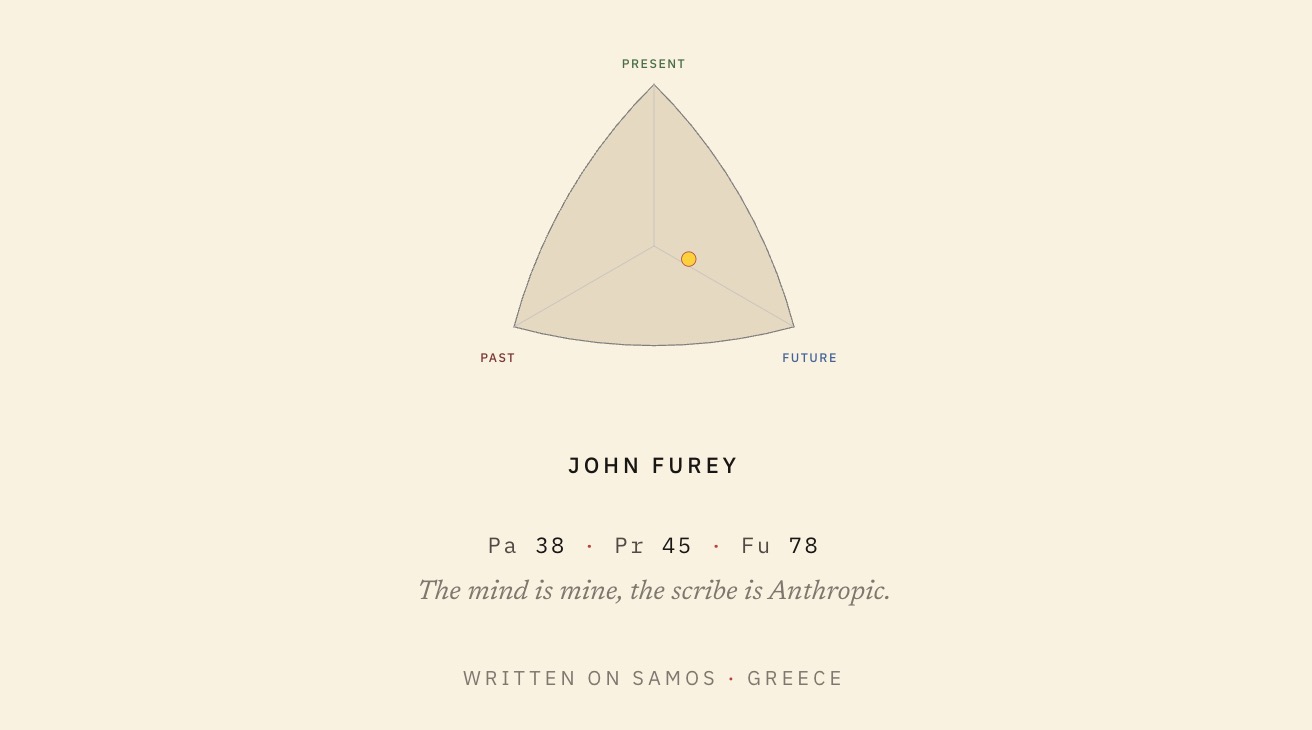
The mind moves in three directions in time. Backward, toward what has already happened and been proven. Forward, toward what has not happened yet and might. And it settles, sometimes, into what is actually going on right now. Every one of us travels all three. We simply lean, each in our own proportion, and the lean shapes what we notice and what we trust.
The three names.
Years ago, when I first had to give these three directions names, I did not call them past, present and future. I called them, and the order matters, Possibility, Probability and Certainty. I want to tell you why, because it turns out the names were doing more work than I understood at the time.
Think of the future as everything that could still happen. Not one outcome. All of them at once, held open, none of them yet real. A physicist would call that a wave that has not collapsed, and I am borrowing the picture, not the physics. I called it Possibility, and I meant the infinite kind. Nothing has been decided. Everything is still available.
Then something happens. Out of all the things that could have occurred, one of them actually does. The infinite narrows to the probable, and the probable narrows to the single real event. That narrowing, that fall from everything-that-could to the-one-thing-that-did, is the present. I called it Probability, the moment the open wave drops into one outcome.
And then it is done, and it becomes memory. Fixed. Verified. Closed. The thing that happened is now the thing that certainly happened, and no other version of it survives. That is the past. I called it Certainty, because after the fall there is nothing left to decide. There is only what was.
Possibility, then Probability, then Certainty. Before the fall, the fall, and after it. I did not fully see, thirty years ago, that I had named the three stages of a wave dropping into a fact.
The darkroom.
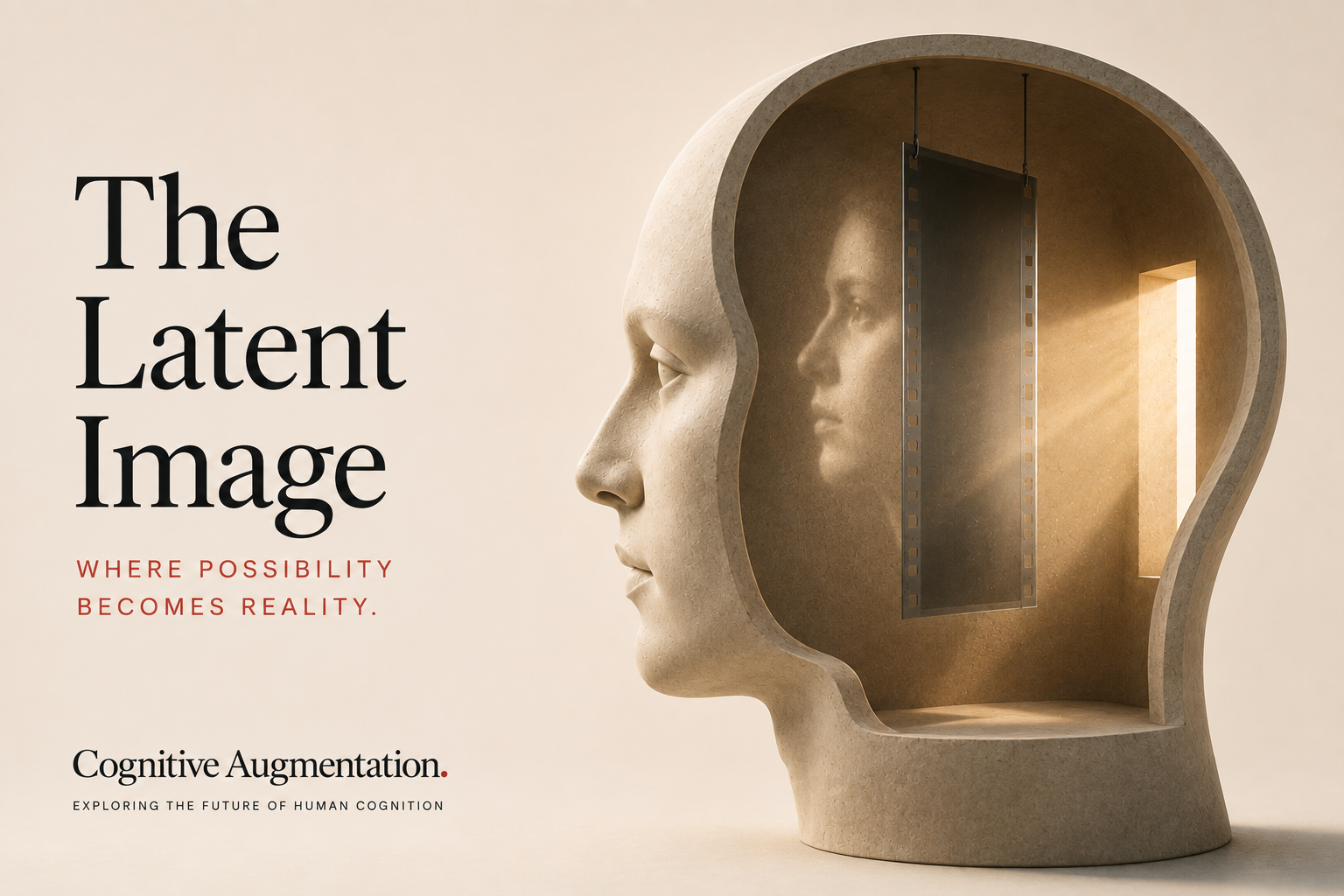
I trained as a photographer, and I think that is why the shape sat easily in my hand long before I could explain it. A photograph is a collapse. Light floods the film and leaves a latent image, invisible, holding everything the lens caught and none of it yet fixed. In the developing bath one version rises out of the possible into the actual. Then the fixer makes it permanent, and what was open becomes a print you can hold, unchangeable, a memory of a light that left the world minutes ago. Possibility in the latent image. Probability in the bath. Certainty in the print.
Now lay that across McGilchrist. The open kind of attention, the one that holds the whole thing before deciding what it is, sits easily with Possibility. It is at home in the not-yet-fixed, in the ambiguous, in the space where several things are still true at once. The grasping kind, the one that names and files and makes still, sits easily with Certainty. It works with what has already fallen, what is fixed and safe to pick up. And the present, the fall itself, is what carries you from the one to the other. It is not really a location in the head at all. It is a movement. The instant the open becomes the fixed.
The machine on
the desk.
Which brings me to the machine on my desk, and to the reason I could not leave this alone on a Sunday.
Ask what an artificial intelligence actually is, on this map, and something comes into focus. It is trained on the recorded past, on everything that has already been written down and closed into text. That is its whole world. Certainty, in staggering quantity. And the way it works, word by word, is by probability. It looks across everything that has ever been said and it collapses that field into the most likely next word, and then the next, and then the next. It is, quite literally, a collapse engine. It is extraordinarily good at the fall. That is the thing it does.
But notice what it never touches. Possibility, the real kind, the infinite open field before anything has fallen, is not available to it. When a machine appears to invent, it is not holding the future open. It is sampling the past at enormous speed and letting probability drop.
What looks like imagination is the fall wearing the costume of creation.
The genuinely open space, the latent image with everything still in it, is the one room the machine cannot enter.
This is the reverse of the thing we have been taught to fear. The story we are told is that the machine will take the creative work, the future-facing work, and leave us the drudgery. The map says it runs the other way. The machine is a magnificent past and a magnificent fall. What it cannot do is stand in the open, before the collapse, and hold everything that might still be. That standing-open is the human part. It always was.
McGilchrist said the grasping servant was never meant to rule. There is a line often hung on Einstein, though it seems to have been Bob Samples who really wrote it, that the rational mind is a faithful servant and the intuitive mind a sacred gift, and that we have built a world which honours the servant and forgets the gift. The same instinct, arriving at the same place seventy years apart. Here is a servant grown vaster than any of them could have pictured, faster and better read than any mind alive, and still a servant, because it can only work with what has already dropped into place. The master’s work is a different kind of work. The master holds the possibility open long enough to choose well. And the choosing, the fall, the single real decision made by a person in a room on an ordinary afternoon, stays exactly where it has always been.
That is the augmentation I keep turning over. A machine that remembers everything and collapses it beautifully, set beside the one creature who can still hold the picture open before it is fixed. The machine does not dream. It develops. The dreaming is ours.
It is only speculation. But it is Sunday, the light is good, and the image has not finished developing yet.
John Furey has spent thirty years studying how the mind moves in time, and what a machine can and cannot do with it.
On Cognitive Augmentation · A Sunday Speculation