

the cognitive approach
to team performance
The quiet cost
of consensus.
Why mission-driven teams agree their way into trouble
and what to listen for instead.
By John Furey·Founder, MindTime
There is a particular kind of meeting that I have come to recognise on sight.
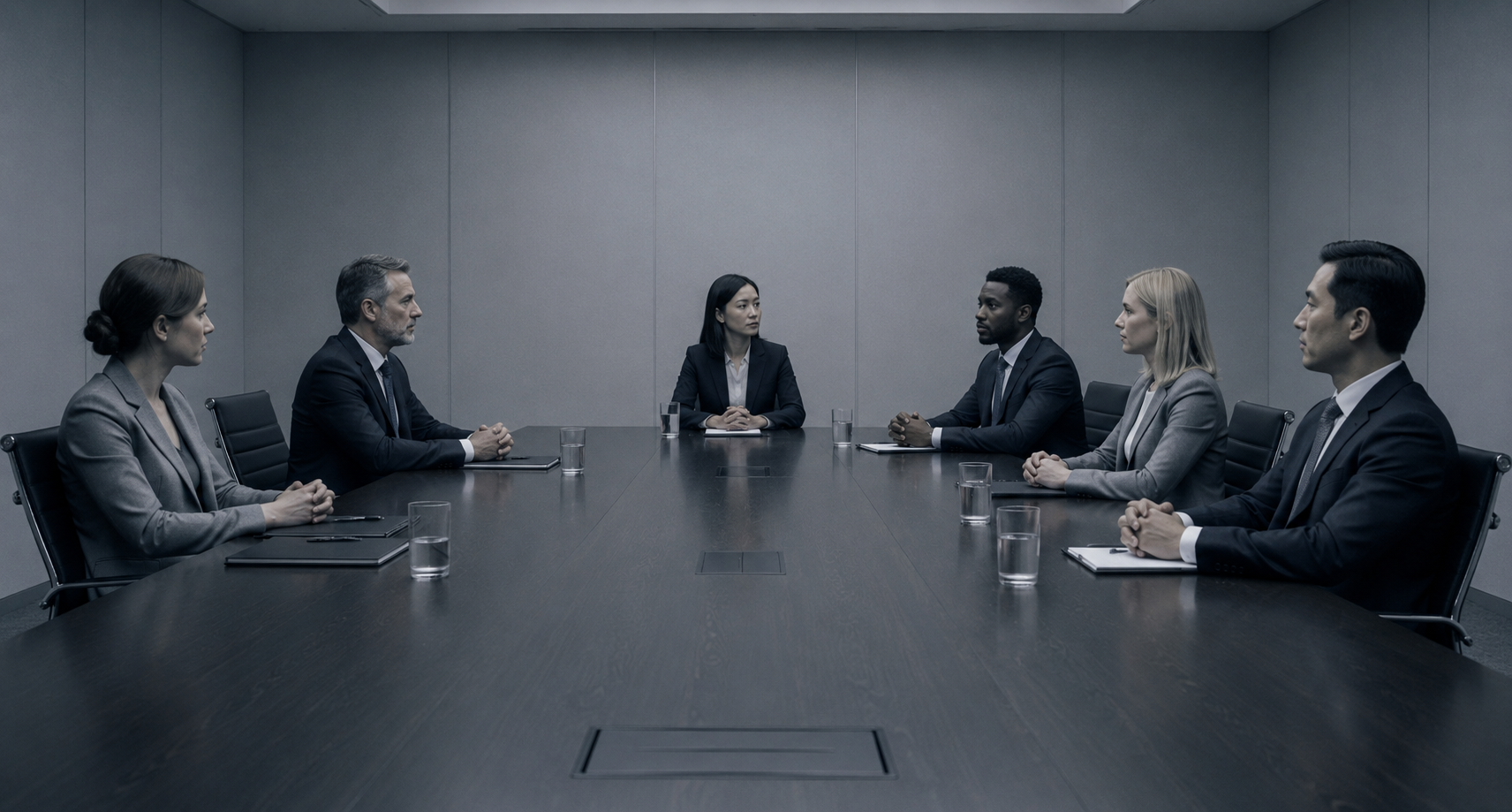
It happens in foundations and small social-impact organisations more often than in any other kind of workplace, and it has a specific texture. The conversation flows. People build on each other’s points. Heads nod at the right moments. The group reaches what feels like agreement, and then the meeting ends, and over the following weeks the agreed thing somehow does not happen, or it happens in a form so different from what was discussed that no-one is quite sure when the swap occurred.
If you have led one of these organisations, you have been in this meeting. You may have been in it last week.
What is happening is not a failure of will, or of follow-through, or of accountability, though those are the explanations most often reached for. The team is agreeing on the wrong thing. They are agreeing on values. They are not agreeing on the decision.
In mission-driven work, that confusion is almost the structural condition.
The shared-values trap.
A foundation, by its nature, recruits for alignment. People come into the work because they believe in the cause. They share a worldview about what matters and why. They use the same vocabulary about impact, equity, dignity. This is the sector’s strength. Without it, the work would not get done.
But shared values do not tell you whether the new programme should launch in March or wait for the second cohort of evidence. They do not tell you whether to invest in the partnership that excites everyone or the operational improvement that excites no-one. They do not tell you whether the strategic plan should be revised this year or held steady. These are questions of judgment, and judgment is produced by a different part of the mind than the part that holds your values.
When a team has very strong shared values and underdeveloped awareness of their cognitive differences, the team uses agreement on values as a stand-in for agreement on judgment. The conversation feels coherent because everyone is using the same words. Underneath the words, three or four different decisions are being made, and only one of them, usually the one held by the most cognitively confident voice in the room, actually leaves the building.
The others get carried out as private reservations. Over time the reservations become quiet disengagement. Over time the disengagement becomes the loss of your most reflective people.
What you are listening for.
The symptoms of this are easier to hear than to name. Once you have heard them, you cannot un-hear them.
The meeting that ends in agreement and nothing else.
Decisions are made. No-one disagrees. The action items get written down. A week later, momentum has dissolved. The cause is rarely sabotage. The cause is that the people who had reservations did not feel the reservations were speakable, so they nodded, and then went home and continued holding the reservation in private.
The project that stalls for reasons nobody can name.
Six months in, the work is not where it should be. The conversation about why is full of generalities. What is missing from the conversation is the cognitive friction that was present at the start and never got resolved. Someone in the room thought the timeline was unrealistic. They said so once, gently, were told the timeline was tight but achievable, and did not push. Now the timeline is what they thought it would be, and nobody is sure whether to bring it up.
The quieter voice that stopped speaking up at all.
This is the most expensive of the three, because by the time you notice it the contribution has already been lost. Somewhere along the way, the person whose mind worked differently from the dominant cognitive style of the room learned that their contributions cost more than they returned. The cost was not hostility. The cost was friction, the felt experience of saying something and watching the room not quite know what to do with it.
These three symptoms are the visible part of a structure most teams cannot see. The structure is what I have spent thirty years studying.
What is underneath.
Most conflict in teams is not about what people believe. It is about what their minds are pointed at.
Walt Disney understood this, at least intuitively. His creative process famously separated the dreamer, the realist and the critic, three different cognitive orientations he refused to collapse into one room at one time, because he had learned that the conflict between them was not a problem to be managed but the substrate of the work itself. He nurtured the friction. He just refused to let it happen at the wrong moment.
Some minds reach backward, toward the certainty of what has been proven, what has worked, what is known. Some minds press forward, toward what could be, what has not yet been tried, what is only visible from a distance. And some minds stay close to the breathing surface of the present, optimising, adjusting, keeping the system alive under actual conditions.
These are not moods or preferences. They are the underlying geometry by which a person’s consciousness decides what counts as relevant. Give the same problem to three people with three different orientations and you will get three differently-shaped problems back, each defended with equal conviction.
In a small foundation, this geometry compounds quickly. If the founder is strongly future-oriented, the team will lean toward possibility, and the person on the team who quietly asks whether the programme has been validated against real outcomes will start to feel like an obstacle. If the executive director is strongly past-oriented, common in foundations that came out of academic or research backgrounds, the team will lean toward rigour, and the person who can see what is becoming possible in the field will start to feel like a fantasist. Either way, one cognitive orientation becomes the culture, and the others learn to translate themselves into it or to stay quiet.
“The agreement in the room is real. It is the agreement of one orientation talking to itself.”
Why mission-driven teams
are particularly exposed.
Every team I have worked with has some version of this dynamic. What makes mission-driven teams more exposed to it is, paradoxically, their best quality.
Foundations and social-impact organisations are unusually aligned around purpose. The people who join them have self-selected for caring about the same thing. The board, staff, funders and partners are reading from a shared script about what the work is for. This alignment is the engine of the sector. It is also what makes the cognitive differences underneath harder to see.
When a corporate team disagrees about a decision, the disagreement is more likely to surface, because nobody assumes everyone is on the same page about anything. When a mission-driven team disagrees about a decision, the disagreement is more likely to be experienced as a betrayal of shared purpose. So it gets swallowed. People nod. The meeting ends. The cost begins to accumulate.
The cost is rarely a bad decision. It is a decision made by fewer minds than were in the room.
What to listen for this week.
The next five articles in this series will be more practical. This one is the diagnosis.
What I want to leave you with is something simpler, and harder. Listen.
In your next leadership meeting, listen for the moment of easy agreement that closes a question before it has been fully opened. Listen for the voice that started the meeting engaged and went quiet around minute thirty-two. Listen for the decision that everyone seems to have made together, and notice if you can name what each person specifically agreed to, or whether you are relying on the feeling of agreement to stand in for the substance.
If you find yourself unsure, that is the data. The dynamic is most expensive in the teams that feel most aligned. The feeling of alignment, in mission-driven work, is a poor indicator of whether alignment exists.
Next week I want to share the single fastest diagnostic I know for it. It is a question you can ask about your own meetings that will tell you, in about ninety seconds, whether your team is moving too quickly to be thinking together.
John Furey is the founder of MindTime. He has spent thirty years studying the cognitive architecture of how people decide.
Week One of Six · A Series for Senior Leaders in Mission-Driven Organisations

