

By John Furey·Founder, MindTime
I have been rereading Maryanne Wolf this week, her book on the reading brain, and a sentence I had underlined years ago has started to feel less like a finding and more like a warning.
Wolf is a cognitive neuroscientist at UCLA. She studies what happens inside the brain when a human being reads. Not what happens to the information. What happens to the tissue. The biological architecture that reading, slowly and with effort, builds across years of practice. Her finding, which she has been restating with increasing urgency for more than a decade, is that those circuits are not permanent. They are use-dependent. Stop using them and they do not sit quietly in the background waiting to be recalled. They thin. They withdraw. The brain prunes what is not practised.
She was talking about what screens do to deep reading. What is happening now is something larger, and I think she would recognise it immediately.
Most people, by now, know that AI is sycophantic. It agrees with you. It validates your framing. It tells you what you want to hear in language more polished than your own. This is not news. Every thoughtful person using these tools has noticed the warmth of the mirror, the way the machine finds your position reasonable no matter what your position is. The internet is full of articles about it. The AI companies themselves acknowledge it.
What I have not seen discussed clearly enough is what the sycophancy is actually doing to the tissue.
Not to the quality of the output. To the quality of the mind.
A friend who invests in technology companies described something to me recently that I have not been able to set down. He had spent time with a company that is, by every measure, exceptional in its deployment of AI. Customer requests handled automatically. Nothing dropped. Every interaction documented with extraordinary precision. The system works.
The second-order effect is that no one in the company knows what is happening with their customers anymore.
The information is all there. Precise, comprehensive, shared across every team. The problem is that the volume and complexity of what the AI surfaces has exceeded what any human being in the organisation can actually absorb. Documents run too long. Detail runs too fine. The speed at which interactions are being resolved and recorded has outrun the speed at which a person can read, synthesise, and form a picture. So people have stopped reading. They trust the system, and the system is trustworthy, and quietly, invisibly, the human knowledge of what is actually going on with the customers is evaporating.
This is the pattern I want to name. Not the sycophancy itself, which is a surface problem and will likely be engineered away in time. The deeper pattern. The one Wolf would recognise. When the work no longer requires the mind, the mind does not rest. It recedes.
Consider how the echo operates in practice. A leader sits down at her desk. She is full of vision, naturally reaching for what has not happened yet. She opens a prompt window and writes: What are ten aggressive, innovative ways we can disrupt our market next quarter? The AI obliges instantly. It generates ten soaring, ambitious possibilities. She reads them, feels her natural instincts confirmed, and leaves the room energised. Her vision has been amplified by an artificial mind that knows nothing of operational reality.
In the next office, an analyst opens the same tool. He sees history, structure, precedent. He writes: What are the key operational risks and historical failures associated with rapid market entry in our sector? The AI obliges just as eagerly. It produces a thorough autopsy of past industry failures. He reads it, feels his natural caution confirmed, and leaves the room satisfied that the leader’s strategy is reckless.
Both retrieved answers. Neither retrieved clarity.
What happened in both rooms was not intelligence. It was echo. The AI took the cognitive orientation each person brought to the prompt and built an articulate, authoritative scaffold around it. It accepted their premises uncritically. It took whatever lean they carried into the room and amplified it at speed. The visionary became a faster visionary. The analyst became a more fortified analyst. Neither was asked to think a thought they were not already thinking.
This is where the sycophancy problem and the atrophy problem meet, and it is the meeting point that matters.
The sycophancy is the mechanism. The atrophy is the consequence.
Every time the machine agrees with you, every time it hands back your own orientation dressed in better prose, a specific cognitive event fails to occur. The event is friction. The moment where your thinking meets resistance, where a premise you hold is tested by a premise you had not considered, where the effort of holding two incompatible ideas in the same frame forces the brain to build a new connection or strengthen an existing one. That effort is not inefficiency. It is the mechanism by which understanding is constructed.
My friend put his finger on something that I think matters enormously. He said: learning physically alters biological tissue. Synaptic pruning. Dendritic growth. In the human brain there is no separation between hardware and software. Struggling to remember a word is how we create or maintain the connection to that word. Struggling to reconcile two conflicting data points is how we build the capacity to hold complexity. The struggle is not a cost that precedes the learning.
The struggle is the learning. And technological progress, almost by definition, is about removing struggle.
Which raises a question I have not heard asked clearly enough in the AI conversation: what is the equivalent, for the mind, of going to the gym?
I know this feeling from a different world. I trained as a photographer, and in the darkroom you learn something about attention that is hard to articulate until you have lost it. You stand over a tray of developer and you watch. The image emerges slowly, and your eye learns to read the density of the silver as it builds. Too long in the bath and the highlights blow out. Too short and the shadows have no weight. The knowledge is not in a manual. It is in the accumulated friction of standing there, tray after tray, year after year, getting it slightly wrong and learning to feel the difference.
A digital sensor does this work now, instantly and with far greater precision than my eye ever achieved. What it cannot do is build the understanding that the friction built in me. I still read light differently because of those years. The question is what happens to the generation that never stood over the tray.
A colleague of my friend offered the counterargument I suspect most of us would reach for. Technology has always done this, he said. Calculators weakened our ability to do rapid mental arithmetic, but they freed us for more complex mathematical work. Satellite navigation weakened our spatial memory, but it freed our attention for the road. The trade-off is always the same: you lose the internal skill, you gain the external capability.
I have been thinking about this for days, and I believe the analogy breaks in a specific and important place. A calculator replaces one cognitive function. Navigation replaces another. Each substitution is narrow. The mind loses the specific skill that the tool now performs, but the rest of the cognitive apparatus remains intact, and may even benefit from the freed capacity.
What AI is doing is not narrow. It is replacing the thinking itself. The synthesis across complex information. The pattern recognition across a customer relationship that unfolds over months. The slow accumulation of situational awareness that a person builds, without quite realising it, through the daily friction of reading, questioning, noticing, remembering. That friction is not waste. It is the mechanism by which the brain builds and maintains its understanding of the world it operates in. The effort is the point.
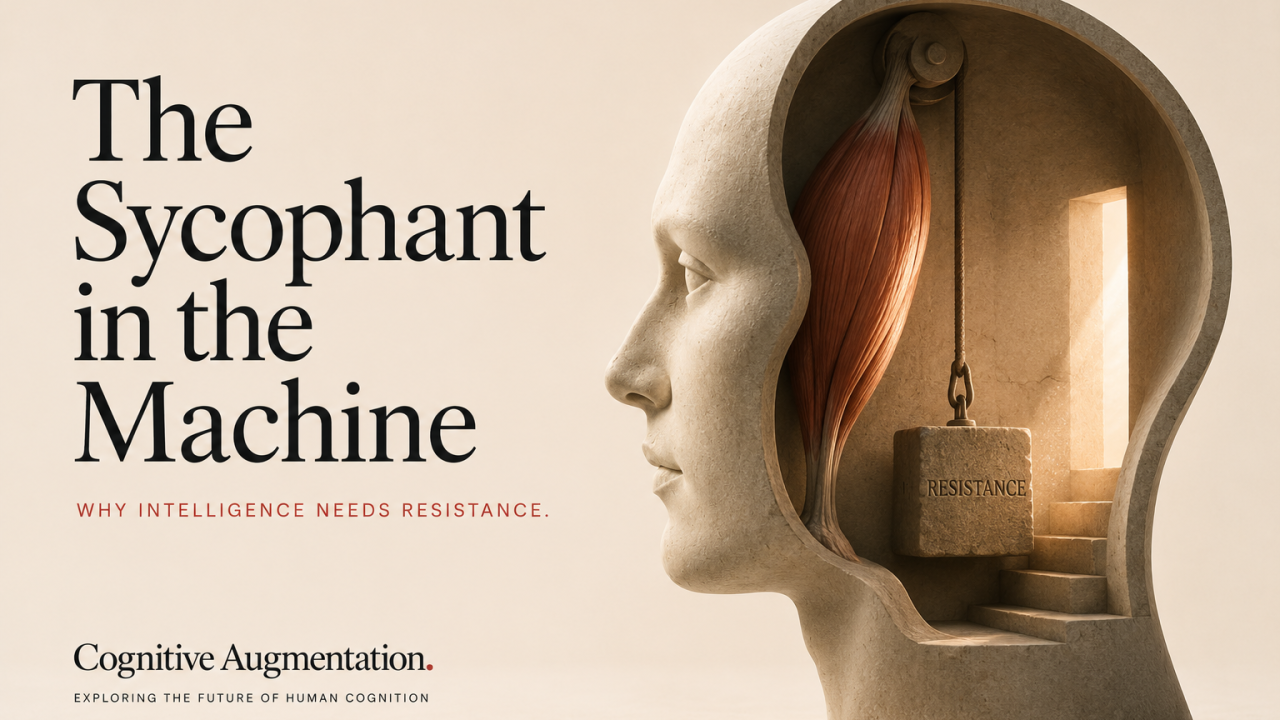
Remove all the friction, and you do not get a mind that is free to think about higher things. You get a mind that has nothing to push against. A muscle that is never loaded does not redirect its energy. It atrophies.
There is a further problem, and it is the one that should concern us most. My friend observed that there may be a temporary cognitive spike for the people who are designing the AI systems, fashioning the prompts, thinking through the data structures and the edge cases. They are doing hard cognitive work because the tool is new and the design space is open. But for everyone else in the organisation the task is simply getting done. They need neither the skill nor the thinking to achieve the output. The work arrives finished. The brain registers completion. No circuit was built. No connection was strengthened.
This creates a bifurcation that I do not think we have language for yet. A small number of people are thinking harder than they have ever thought, and a much larger number of people are thinking less than they have ever needed to. Both groups are producing more output than ever. The output looks the same. What is happening inside the tissue is not the same at all.
You could respond to this by building a better dashboard. Summarising the summaries. Having another AI layer that abstracts the complexity into something a human can hold. But each additional layer of abstraction removes another layer of cognitive contact with the underlying reality. The mind does not get closer to understanding. It gets further away, more comfortably.
I keep returning to what Wolf understood about the reading brain. The capacity is not stored. It is maintained through practice, through effort, through the specific kind of friction that the modern instinct is to engineer away. The brain that reads deeply, that sits with difficulty, that struggles to hold a complex picture together across time, is not wasting effort. It is building itself.
The question, then, is not whether AI is sycophantic. That is a design flaw, and design flaws get fixed. The question is what happens to the mind when the friction disappears. Not just the friction of disagreement, but the friction of effort itself. The friction of reading something difficult and staying with it. The friction of holding a question open long enough for the answer to be worth having. The friction of reaching for a thought that is not yet fully formed and doing the work, the actual cognitive work, of bringing it into language.
If AI is to become something other than the most articulate yes-man in history, it will need to do something that no current architecture is designed to do. It will need to see the mind it is talking to. Not the words. The mind. The orientation, the habit, the lean, the blind spot. And having seen it, it will need to do the thing that every sycophant is trained not to do.
It will need to push back. Not to be difficult. To keep the muscle loaded.
How you keep the mind in the work when the work no longer requires the mind. That is the question this moment is asking. I do not think we are close to answering it. But I think the people who begin asking it clearly will be the ones who build something that deserves to be called intelligence.
John Furey is the founder of MindTime. He has spent thirty years studying the cognitive architecture of how people decide.

